ZIQI Compressor For Global Energy Saving, Welcome To Contact Us.  008615026767628
Language
ZIQI Compressor For Global Energy Saving, Welcome To Contact Us. 008615026767628
The internal piping material in a rotary screw air compressor determines whether the machine develops chronic oil contamination issues at year 3–5 or runs cleanly for its full service life. Carbon steel and galvanized steel — the standard in domestic-grade Chinese compressors — corrode internally within 3–5 years under normal condensate and oil vapor exposure, shedding rust particles that contaminate oil, clog the scavenge line, and prematurely fail the oil separator element. 304 stainless steel — ZIQI's standard specification — is inert to this corrosion mechanism and maintains clean internal surfaces for the machine's full service life. The difference is not about whether corrosion happens. It is about when — and what it costs when it does.
Internal piping is the most overlooked component in air compressor specification. It appears nowhere on standard specification sheets. It is invisible in product photos once the cabinet panels are closed. And unlike airend efficiency or motor power consumption, its effects do not appear in the first year of operation — which is precisely why it is the component that most commonly surprises buyers at year 3, 4, and 5.
The internal oil circuit piping in a rotary screw compressor carries compressed air-oil mixture from the airend through the oil separator, oil cooler, oil filter, and back to the airend for lubrication. This circuit operates continuously under pressure, at elevated temperature, carrying a mixture of compressed air, lubricating oil, and water condensate.
The operating environment inside this circuit — hot, humid, with condensate pooling at low points during shutdown — is among the most aggressive corrosion environments a metal pipe can experience. Carbon steel and galvanized steel, which perform adequately in dry ambient conditions, corrode internally within 3–5 years under this continuous exposure.
The failure pattern from carbon steel internal piping is consistent across installations and predictable in its timing. It does not announce itself dramatically — it produces a slow degradation that most maintenance teams initially attribute to aging separator elements or oil quality issues:
Carbon steel piping looks normal internally. Corrosion begins at water condensate accumulation points — bends, low points, and expansion joints — but has not yet shed significant rust particles. Machine performs to specification.
Rust particles begin contaminating the oil circuit. They accumulate in the oil separator vessel, raising the effective oil level inside the separator. The separator element works harder to coalesce oil droplets, saturating earlier than its rated interval. First unscheduled separator replacement typically occurs at this stage.
Rust particle load increases. The oil scavenge line — a small-diameter tube returning separated oil from the separator vessel to the airend — begins blocking with rust sludge. Oil accumulates in the separator, passes into the discharge air. Separator element replacement every 6–8 months. New separator elements fail faster than old ones — the root cause is never addressed by element replacement alone.
Carbon steel piping corrosion is a specification defect, not a maintenance problem. The only permanent fix is replacing the internal piping with 304 stainless steel — a major workshop job that typically costs more than the original price difference between a domestic-grade and export-grade machine.
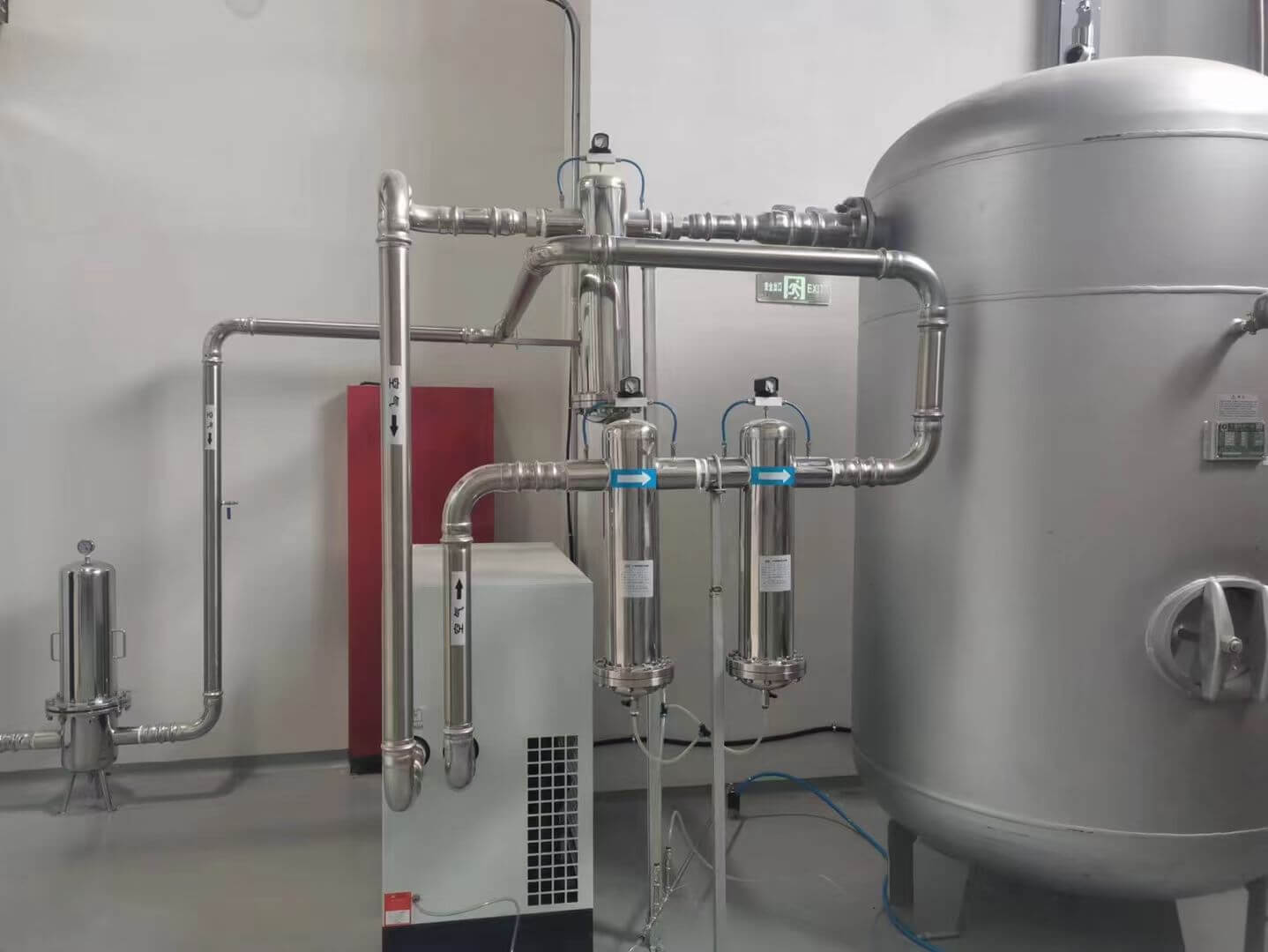 Left: 304 stainless steel press-fit internal piping as standard in ZIQI compressors — no corrosion after years of operation. Right: Carbon steel internal piping from a domestic-grade Chinese compressor at year 3 — internal rust contaminating the oil circuit.
| Specification | 304 Stainless Steel (ZIQI standard) | Carbon Steel / Galvanized (Domestic grade) |
|---|---|---|
| Corrosion resistance | Immune to condensate and oil vapor corrosion under normal operating conditions | Corrodes internally within 3–5 years under normal compressor operating conditions |
| Rust particle generation | None — clean internal surface maintained for machine's full service life | Progressive from year 3 — rust particles contaminate oil, clog scavenge line, accelerate separator failure |
| Separator element interval | 36–48 months (rated interval maintained) | 6–8 months after year 3–4 (rust contamination saturates elements prematurely) |
| 10-year maintenance cost impact | Baseline — rated service intervals maintained | +$10,000–$20,000 in additional separator elements, oil changes, and scavenge line cleaning over 10 years |
| Food/pharma applications | No rust contamination risk in air stream — suitable for food-grade environments | Rust particles can enter air stream via separator — contamination risk in sensitive applications |
| Tropical/coastal environments | No accelerated corrosion in high-humidity environments | Corrosion accelerates significantly in tropical humidity — 40–60% faster than continental climate installations |
The answer is simple: cost. 304 stainless steel internal piping costs approximately $300–$600 more per machine on a 75kW unit than carbon steel or galvanized steel alternatives. In a market where purchase price is the primary competitive variable for domestic-grade manufacturers, this cost difference is absorbed into a lower selling price rather than into better specification.
The problem is that the $300–$600 piping cost saving appears in year one — while the $10,000–$20,000 maintenance cost consequence appears in years 3–8. For a buyer focused on purchase price, the savings are real and immediate. For a buyer calculating total cost of ownership, the math runs in the opposite direction.
For the full export-grade vs domestic-grade component comparison including piping, motor, airend, and controller, see our export grade vs domestic grade guide. For how piping specification interacts with food processing air quality requirements, see our oil-free compressor for food processing guide.
304 stainless steel press-fit piping throughout — confirmed in writing with internal cabinet photo before purchase. All 4 component certificates within 24 hours.
The internal oil circuit piping carries compressed air-oil mixture under pressure at elevated temperature with condensate present — one of the most corrosive environments a metal pipe can experience. Carbon steel and galvanized steel corrode internally within 3–5 years, shedding rust particles that contaminate the oil, clog the oil scavenge line, and prematurely fail the oil separator element. The result is separator replacement every 6–8 months instead of the rated 36–48 months, plus recurring oil-in-air complaints that maintenance cannot permanently resolve without replacing the piping itself. 304 stainless steel is inert to this corrosion mechanism.
Request an internal cabinet photo from the manufacturer before the panels are closed. 304 stainless steel press-fit piping is visually distinctive — bright silver/brushed metal push-fit connectors and smooth tubing throughout the oil circuit. Carbon steel piping appears as grey-painted or galvanized steel with threaded connections. Rubber hose connections (found in Tier 3 machines) are immediately identifiable. Always request written confirmation of piping material in addition to the photo — verbal claims are not sufficient for procurement documentation.
The additional cost of 304 stainless steel internal piping vs carbon steel on a 75kW compressor is approximately $300–$600 at the manufacturing level. Over a 10-year service life, the maintenance cost difference from premature separator element replacement caused by carbon steel corrosion typically exceeds $10,000–$20,000. The stainless steel premium pays back within the first additional separator replacement event. ZIQI includes 304SS piping as standard specification — it is not a paid upgrade.
Yes — significantly. In high-humidity tropical environments (Southeast Asia, coastal Africa, coastal Middle East), carbon steel internal piping corrodes 40–60% faster than in continental temperate climates. A machine that develops carbon steel corrosion problems at year 4–5 in Shanghai may exhibit the same issues at year 2–3 in Ho Chi Minh City, Lagos, or Oman's Muscat coast. 304 stainless steel eliminates this climate sensitivity — it performs identically in tropical humidity and continental dry climates.
No — not permanently. Replacing the separator element and cleaning the scavenge line resolves the symptoms temporarily, but the rust particle source remains. The particles resume contaminating the new element within weeks. The only permanent fix is replacing the internal piping with 304 stainless steel — a major disassembly job that in most cases costs more than the original purchase price difference between a domestic-grade and export-grade machine. This is why piping material specification at the time of purchase is critical — it cannot be economically remediated after the fact.
Sources: ZIQI Compressor Group field service data; ASTM A240/A240M (304 stainless steel specification); corrosion rate data for carbon steel in humid condensate environments; separator element cost model based on $1,200–$1,800/replacement at 6–8 month intervals vs 36–48 months.
Not an upgrade. Not an option. The baseline.
Written piping spec + internal cabinet photo + all 4 component certificates within 24 hours.
QUICK LINKS
PRODUCTS
CONTACT US
 Email : inquiry@ziqi-group.com
 Tel: +86-15026767628
 Add:Building 2, No. 205, Jianding Road, Fengjing Town, Jinshan District, Shanghai City.China
PLEASE CONTACT US.

ZIQI Compressor (Shanghai) Co., Ltd
Copyright © 2026 ZIQI Compressor (Shanghai) Co., Ltd - All rights reserved.

