ZIQI Compressor For Global Energy Saving, Welcome To Contact Us.  008615026767628
Language
ZIQI Compressor For Global Energy Saving, Welcome To Contact Us. 008615026767628

Disclosure: This guide is published by ZIQI Compressor Group, which manufactures the OFW and OFD oil-free compressors discussed below.
In food and beverage manufacturing, compressed air is often called the "fourth utility": it drives conveying, packaging, fermentation aeration and PET bottle blowing. When that air touches ingredients, drinks or primary packaging, oil carryover that is tolerated in general manufacturing becomes a contamination risk. As a Chinese compressor manufacturer that builds oil-free systems for food plants, ZIQI wrote this guide to help buyers decide which oil purity class each process needs and which compressor technology can deliver it. It uses ISO 8573-1, the international standard for compressed air purity, and refers to food-safety schemes such as BRCGS and SQF, which typically expect compressed air that contacts food to be controlled and risk-assessed.
Quick Answer: Choose the oil class from the contact risk of each process. Air that directly touches food, drinks or primary packaging is commonly specified at ISO 8573-1 Class 1 or Class 0 in the plant's own specification and risk assessment. Class 0 is defined by agreement between supplier and buyer and is stricter than Class 1, which allows a total oil content of up to 0.01 mg/m³. Indirect-contact and utility air can often use a lower class. A native oil-free compressor removes oil at the compression source, so purity does not depend on filter condition, while an oil-injected compressor with filtration can also reach low oil levels if the filters are maintained and monitored. ZIQI offers two oil-free designs for these applications, OFW water-lubricated and OFD dry.
In food plants, compressed air is rarely just a motive force. It often touches ingredients, drinks or packaging surfaces, so oil that reaches the product can alter taste and odor, fail a quality check and lead to a recall.
Oil carryover in the air stream ➔ residue builds up in pipework and dead legs ➔ residue reaches food, drinks or packaging surfaces ➔ taste, odor or contamination problem ➔ failed quality check or audit finding ➔ possible recall.
Oil in compressed air exists as liquid droplets, aerosol and vapor. An oil-injected screw compressor leaves some oil in the air stream before filtration, and the amount depends on the separator and its condition. As an illustration only: an oil-injected compressor delivering 15 m³/min for 16 hours a day over 300 days, with 3 mg/m³ of oil carryover, would pass about 13 kg of oil into the air system each year (15 × 60 × 16 × 300 × 3 mg ≈ 12,960 g). Real carryover depends on the machine and its filtration.
A common misconception is that switching to food-grade (NSF H1) oil makes compressor air food-safe. H1 lubricants are registered for incidental food contact, but they are still hydrocarbon-based oils. They do not replace an air purity specification, so the oil class of the air still has to be specified and verified by test.
ISO 8573-1 classifies compressed air by solid particulates, water vapor and total oil content, which covers liquid, aerosol and vapor. For a mechanical comparison of how oil-free and oil-flooded designs reach these classes, see the oil-free vs oil-flooded screw compressor comparison.
| ISO 8573-1 Class | Total Oil Content (mg/m³) | Typical Food and Beverage Application | Typical Compressor Type |
|---|---|---|---|
| Class 0 | As specified by supplier and buyer; stricter than Class 1 | Direct contact: ingredient agitation, PET bottle blowing, aseptic packaging, food spraying | Water-lubricated (OFW) or dry oil-free screw (OFD) |
| Class 1 | ≤ 0.01 | Direct and indirect contact, depending on your risk assessment | Oil-free compressors, or oil-injected systems with maintained filtration |
| Class 2 | ≤ 0.1 | General pneumatic tooling, loading dock operation, heavy pneumatic conveying | Oil-injected screw with precision filters |
| Class 3 | ≤ 1.0 | Maintenance workshop, non-production utility air | Oil-injected screw compressor |
The application column is indicative. Set the class for each process in your own risk assessment.
Class 0 is not a fixed numerical value like Class 1. It is a specification agreed between the equipment supplier and the buyer, and it must be stricter than Class 1. ZIQI supplies ISO 8573-1 Class 0 test information for its oil-free models; ask for the report for the exact model, and check what was measured and under which conditions.
A food and beverage plant has several stages, each with its own pressure and purity demand. The matrix shows typical ranges and typical configurations. Set the values for your plant from your own process specification.
| Application | Typical Pressure (bar) | Oil Class Typically Specified | Typical Configuration |
|---|---|---|---|
| PET Bottle Blowing | 25 – 40 | Class 0 or Class 1 (direct contact) | Dedicated high-pressure train; GAH reaches 30 bar and 35–40 bar needs an additional booster stage. Confirm the oil-free configuration with ZIQI engineering |
| Aseptic Food Packaging | 6 – 8 | Class 0 or Class 1 | OFW water-lubricated + desiccant dryer |
| Dairy Processing and Mixing | 5 – 7 | Class 0 or Class 1 | OFD dry oil-free + dryer sized for the required dew point |
| Beverage Filling and Capping | 6 – 7.5 | Class 0 or Class 1 | OFW water-lubricated + dryer and filtration |
| Baking and Coating Spray | 4 – 6 | Class 0 or Class 1 | OFW (variable-frequency models available) + sterile filter at the point of use |
| Fermentation Tank Aeration | 2 – 3.5 | Oil-free with sterile filtration | Oil-free unit sized for the required low pressure, with sterile filtration at the tank. Confirm with ZIQI engineering |
| Pneumatic Conveying (Powders) | 3 – 5.5 | Class 0 or Class 1, with a low pressure dew point | OFD dry oil-free + desiccant dryer (commonly specified at -40°C pressure dew point) |
| Supplements and Pharma-Grade F&B | 6 – 8 | Per your specification and validation plan | OFW or OFD, with a standby unit if your validation plan requires it |
PET bottle blowing is a special case. It needs far higher pressure than standard 7 bar plant air, commonly 25 to 40 bar. Because the blowing air contacts the bottle, the oil class has to be specified and verified, and oil carryover has to be controlled by oil-free compression or by separation and filtration. ZIQI's GAH high-pressure screw compressors reach 30 bar; 35 to 40 bar, for example for carbonated drinks, requires an additional booster stage. Confirm the configuration with ZIQI engineering before you specify it. For sizing, see the PET bottle blowing pressure sizing guide.
Oil-free rotary screw compressors come in two main designs, OFW (water-lubricated) and OFD (dry). Both keep oil out of the compression chamber, but they differ in how the chamber is sealed and cooled.
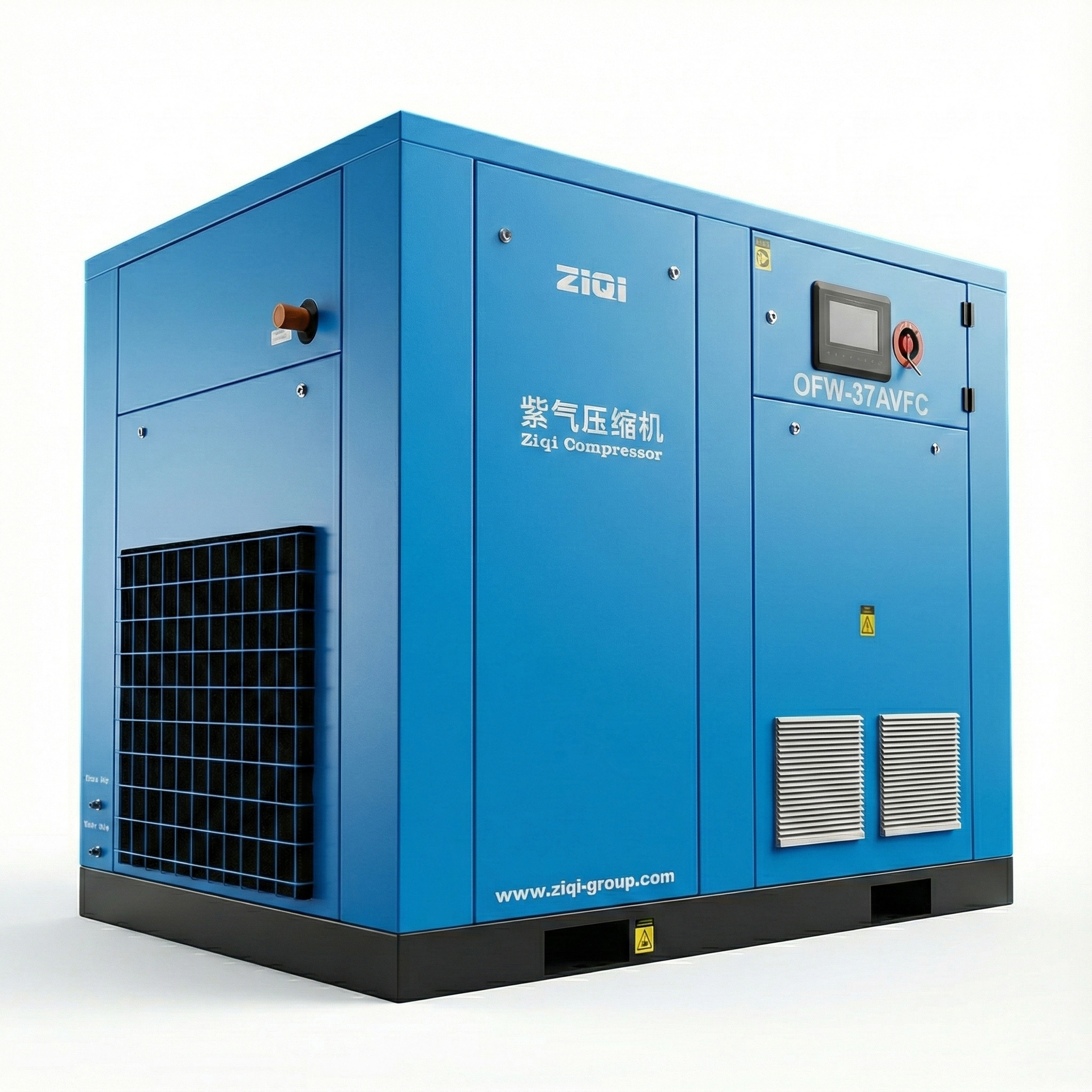
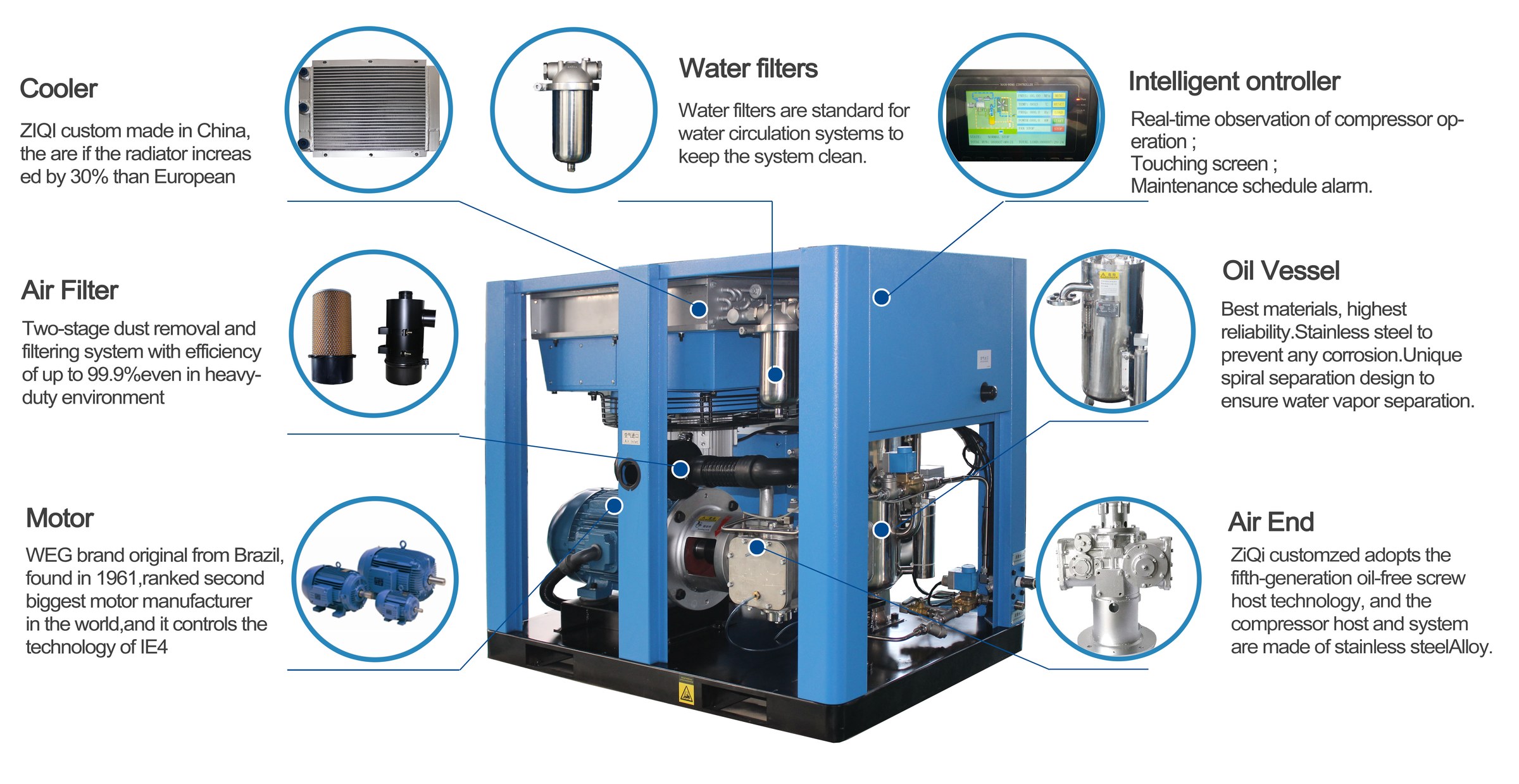
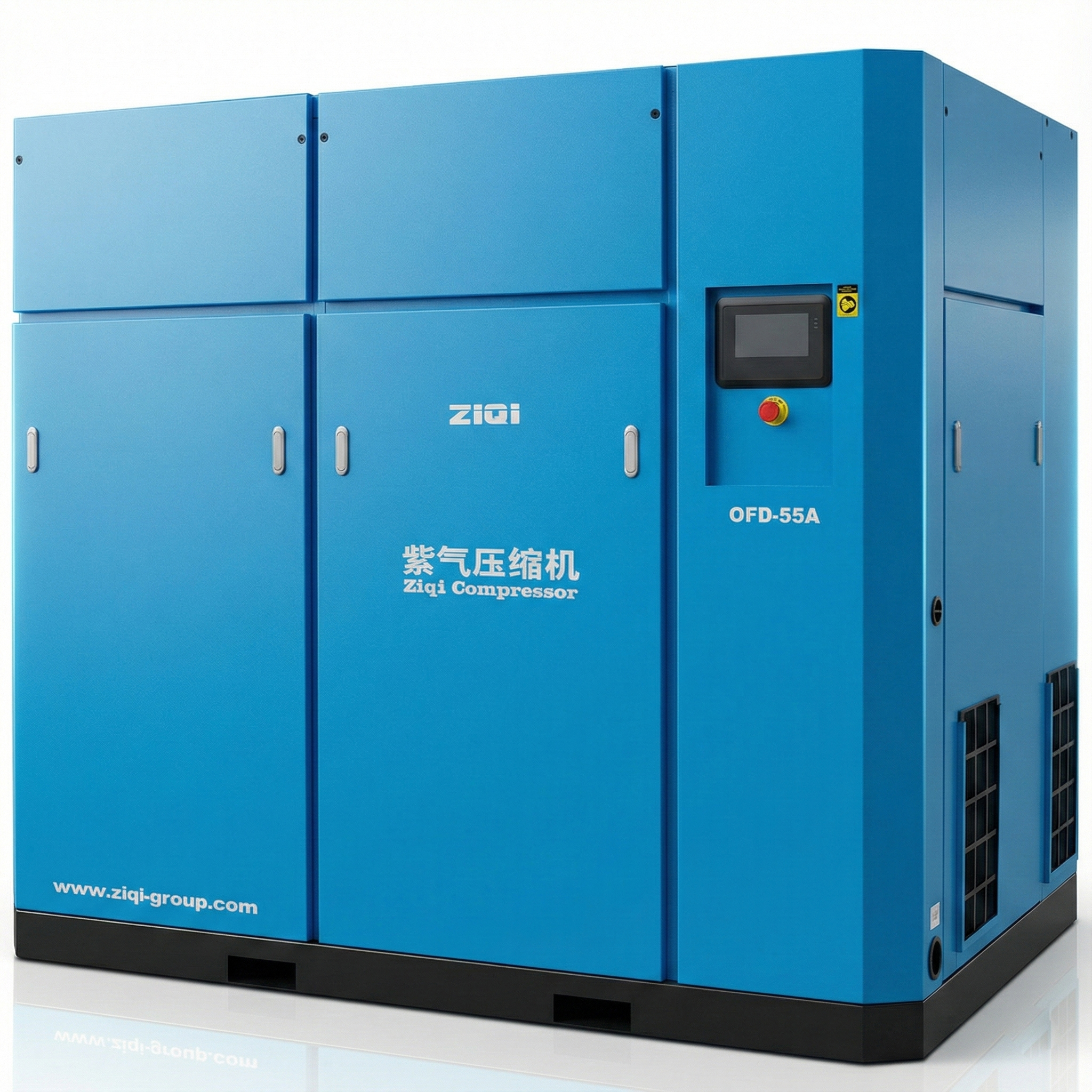
The OFW water-lubricated compressor uses purified water instead of oil to lubricate, seal and cool the compression chamber. It is a single-screw design with polymer composite star wheels and a stainless steel casing, and the ZIQI OFW range covers 7.5 to 250 kW. Because water absorbs heat during compression, the discharge temperature stays close to the suction temperature, within about 45°C according to the OFW brochure. For specifications, see the oil-free screw compressor (OFW) page.
The OFD dry oil-free compressor introduces no liquid into the compression element. Timing gears keep the rotors synchronized, and the rotors are typically protected by anti-friction coatings. Without liquid cooling, dry compression discharges at a much higher temperature, roughly 150 to 200°C before cooling, so dry designs usually use two-stage compression with intercooling. The gearbox lubricant is isolated from the compression chamber by seals. For specifications, see the oil-free dry screw compressor (OFD) page.
| Comparison Dimension | OFW Water-Lubricated Series | OFD Dry Oil-Free Series |
|---|---|---|
| Internal compression medium | Purified water | None |
| Typical discharge temperature | About 45°C (isothermal-type compression) | Roughly 150–200°C before cooling |
| Compression element | Single-screw design with polymer composite star wheels and a stainless steel casing | Dry screw rotors synchronized by timing gears |
| Where lubricant is present | Bearings are grease-lubricated, with an air chamber between the shaft seal and the bearing | Gearbox lubricant, isolated from the compression chamber by seals |
| Maintenance | Ask for the maintenance schedule of the exact model | Ask for the maintenance schedule of the exact model |
Selection advice: both designs can supply Class 0 air when specified for it. OFW suits processes where a low discharge temperature and a water-based seal matter and a purified water supply is available. OFD suits sites without a purified water supply. Whichever you choose, request the ISO 8573-1 test report and the maintenance schedule for the exact model.
Audit the control points across the production line. Decide whether the compressed air is in direct contact with food or drinks (for example ingredient transport or product flushing), in indirect contact (for example carton folding), or a utility. For any direct contact, set the oil class in your specification, Class 1 or Class 0, and verify it by test.
Segment the pneumatic demand. Standard packaging typically runs at 7 to 8 bar. If PET blow molding is required, supply it from a dedicated high-pressure train, so the rest of the plant is not over-pressurized and then regulated down.
Compare ambient plant temperature, purified water availability, and the maintenance plan. OFW suits sites where low discharge temperature and a water-based seal matter and a purified water supply is available. OFD suits sites without a purified water supply. Request the test report and maintenance schedule for the exact model.
An oil-free compressor removes oil from the compression source, but moisture and dust remain. Design the downstream chain with a dryer sized for the required dew point (for example a desiccant dryer specified at -40°C pressure dew point), particulate and coalescing filters, activated carbon where odor is a concern, and sterile filters at the point of use.
Water-lubricated oil-free screw compressors, 7.5 to 250 kW, with water instead of oil in the compression chamber.
View SpecificationsDry oil-free screw compressors with no liquid in the compression chamber.
View SpecificationsWhat air quality class do food manufacturers need?
There is no single class that applies to every plant. Food-safety schemes such as BRCGS and SQF typically expect compressed air that contacts food, drinks or primary packaging to be controlled and covered by a documented risk assessment. In practice, the oil class for direct-contact air is set in the plant's own specification under ISO 8573-1, commonly Class 1 or Class 0. Class 0 is defined by agreement between supplier and buyer and is stricter than Class 1, which allows a total oil content of up to 0.01 mg/m³.
Can I use an oil-injected compressor with downstream filters for food?
It can reach low oil levels, but the result depends on the condition of the separators and filters. Filter performance changes with operating temperature and maintenance, and a saturated or damaged element can let oil pass without being noticed. Many food plants therefore specify an oil-free compressor for direct-contact air, so that purity does not depend on filter condition. If you use filtration, monitor it and test the air regularly.
What pressure does PET bottle blowing require?
PET bottle blow molding typically uses compressed air at 25 to 40 bar, far above standard 7 bar plant air. ZIQI's GAH high-pressure screw compressors reach 30 bar; 35 to 40 bar, for example for carbonated drinks, requires an additional booster stage. Because the blowing air contacts the bottle, specify the oil class and confirm the exact configuration with ZIQI engineering.
What is the difference between OFW and OFD for food applications?
The difference is how the compression chamber is sealed and cooled. OFW uses purified water in the compression chamber and runs at a low discharge temperature, about 45°C, with a single-screw design. OFD runs with no liquid in the chamber and discharges at a much higher temperature, roughly 150 to 200°C before cooling. Both designs can supply Class 0 air when specified for it. Water supply requirements apply to OFW, so confirm them for your site.
How often should compressed air be tested in food facilities?
Set the frequency in your documented risk assessment and your food-safety scheme. Test the air for particulates, pressure dew point and total oil content, and repeat the test after any change to the compressor, dryer or filters, and when conditions that raise the risk change, such as a hot season or a new process. Continuous monitoring of oil vapor can add an early warning for sudden changes.
What is the difference between Class 0 and Class 1 oil content?
Class 1 is a fixed limit: total oil of 0.01 mg/m³ or less, covering liquid, aerosol and vapor. Class 0 is not a fixed number. It is defined by agreement between the equipment supplier and the user and must be stricter than Class 1. For oil-free compressors, ask for the ISO 8573-1 test report that states what was measured and under which conditions.
What documentation does ZIQI provide for food and beverage audits?
ZIQI can supply technical documentation for the model you select, including ISO 8573-1 Class 0 test information for oil-free units and the equipment specification. Which documents you need depends on your audit and any validation requirements, so list them when you request a quotation. HACCP plans and food-safety certification belong to the food manufacturer and its auditor; the compressor documentation supports the risk assessment.
Tell us your food or beverage process, the oil class you need, and your flow demand. ZIQI's engineering team will recommend an oil-free configuration for your plant.
QUICK LINKS
PRODUCTS
CONTACT US
 Email : inquiry@ziqi-group.com
 Tel: +86-15026767628
 Add:Building 2, No. 205, Jianding Road, Fengjing Town, Jinshan District, Shanghai City.China
PLEASE CONTACT US.

ZIQI Compressor (Shanghai) Co., Ltd
Copyright © 2026 ZIQI Compressor (Shanghai) Co., Ltd - All rights reserved.

