ZIQI Compressor For Global Energy Saving, Welcome To Contact Us.  008615026767628
Language
ZIQI Compressor For Global Energy Saving, Welcome To Contact Us. 008615026767628

Field Engineer
ZIQI Compressor Group · Updated November 2026
Three contract types hide behind the word "OEM". Which one you sign decides who holds the brand, the drawings, the moulds and the CE certificate — long after the invoice is paid.
Published by ZIQI Compressor Group, which manufactures the products discussed in this guide and also builds private-label units for other brands.
200
countries ZIQI exports to
Source: ZIQI About Us page
2007
year ZIQI was established in Shanghai
Source: ZIQI About Us page
60 days
standard lead time for export orders
Source: ZIQI MOQ and lead time guide
ISO 9001
quality management certification held
Source: ZIQI About Us page
The trade uses these three words interchangeably, and that is where the money gets lost. They describe who designed the machine, not how much of it you are allowed to change. A buyer who thinks he signed an OEM agreement and later discovers he signed a private-label agreement has bought a licence to rebadge a catalogue product, not a right to a design.
ZIQI is an air compressor manufacturer established in Shanghai in 2007, and roughly a fifth of the units leaving the plant carry somebody else's nameplate. That experience is the reason this guide is organised around ownership rather than around price. Price differences between the three models are real, but they are a consequence of who carries which risk, never the other way round.
| Contract type | Who designed it | Who owns the design | What you may change | Typical buyer |
|---|---|---|---|---|
| OEM | Buyer, to buyer's drawing or specification | Buyer | Anything within the specification you supplied | An established brand with its own engineering file |
| ODM | Factory, on its own platform | Factory, licensed to buyer | Nameplate, colour, controller language, options and packaging | A brand that wants a distinct-looking product without an engineering team |
| Private label | Factory, catalogue product | Factory | Nameplate, colour, manual, packaging only | A distributor adding a house brand to an existing catalogue |
The distinction has a practical consequence in the first meeting. If you cannot produce a drawing, a material specification or a performance target that differs from the supplier's catalogue, you are not buying OEM. You are buying ODM or private label, and the contract should say so plainly, because the certificate and liability clauses that follow depend on it.
The nameplate is the single most consequential 150 by 100 millimetres on the machine. It carries the brand, the model designation, the serial number, the year of construction, the maximum working pressure and the CE mark when applicable. Every customs declaration, every insurance claim and every service record is keyed to it.
Four things must be settled in writing before the first unit is stamped. The brand name as it will appear, exactly, including spacing and capitalisation. The model designation — whether you keep the factory series designation or invent your own, and if you invent one, whether the factory's internal traceability still records the original platform. The serial-number range reserved for you, so your units never collide with the factory's own shipments. And the ownership of the plate design file itself, because a plate is a small piece of tooling and it should be listed in the tooling schedule rather than left as an afterthought.
A common failure mode is a distributor who orders a house-brand plate, sells well, then tries to move to a second supplier and discovers the plate artwork lives in the first supplier's folder along with the packaging dielines. Put the artwork files in escrow or hold them yourself from day one.
Tooling ownership is where OEM contracts between European or American buyers and Chinese compressor factories break down most often, and the pattern is predictable. The buyer pays for a new canopy pressing die or a custom base frame, the factory amortises the cost across the first order, and neither side writes down who owns the die afterwards.
Canopy die, base frame jig, plate die, packaging dieline, controller overlay. Each gets a line with a cost, a payment trigger and an owner.
Amortised means the factory keeps it and recovers cost per unit. Bought outright means it is your property and must be returnable.
If you leave, what does the factory charge to release the tool, and how many days does it have to hand it over or scrap it on your instruction?
Revision letter, date and the change list. A drawing without a revision is not a controlled document and will not survive a dispute.
For compressor packages specifically, the drawings that matter are not only the general arrangement. They are the wiring diagram, the pneumatic schematic, the controller I/O list and the parameter set loaded at commissioning. The parameter set is the one buyers forget, and it is the reason a second source can build an identical cabinet that runs at a different pressure band and a different duty cycle.
Certification is where a private-label buyer takes on more legal exposure than he expects, and it is the section worth reading twice.
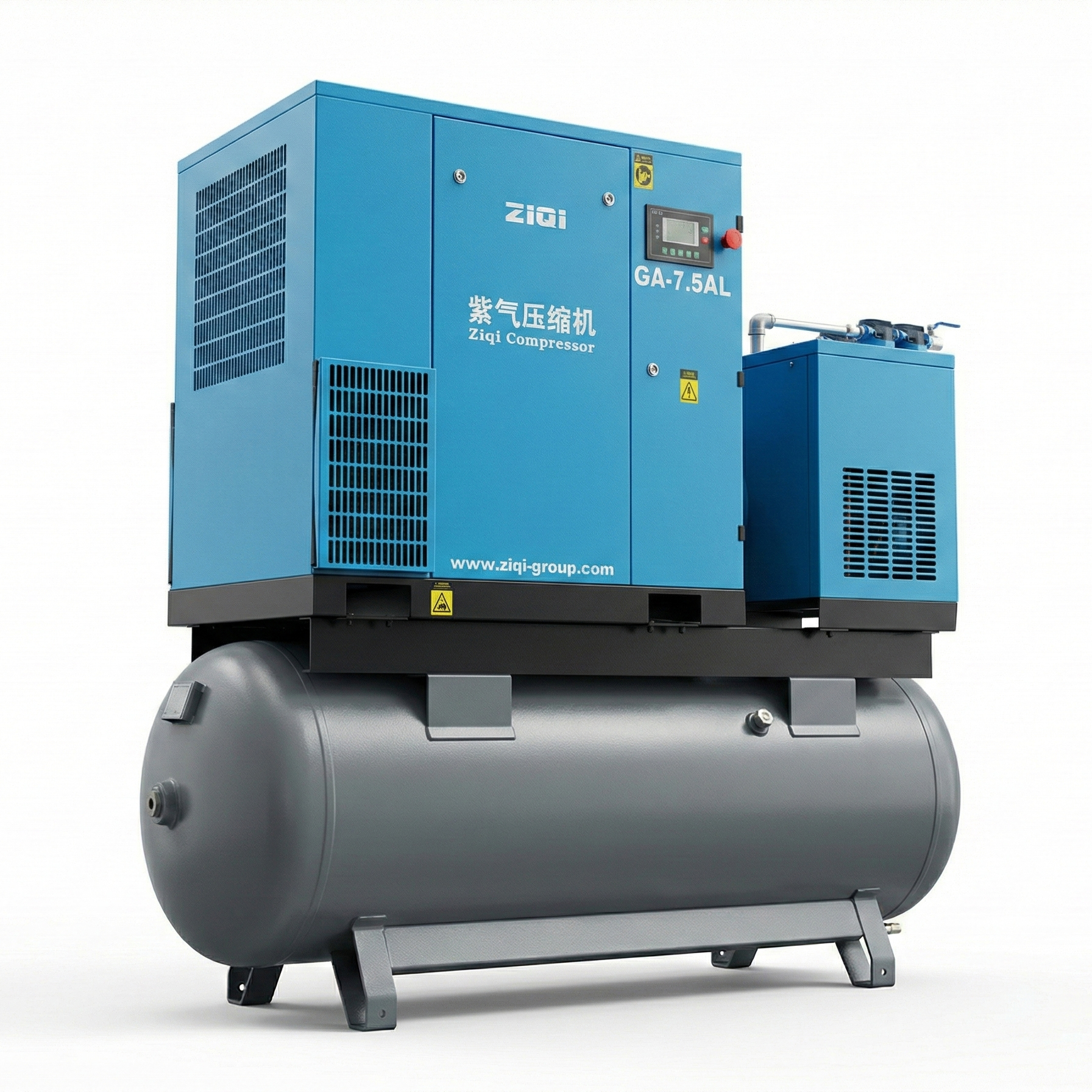
The EU Machinery Directive 2006/42/EC defines the manufacturer as the person who places the machinery on the market under his own name (Article 2, definitions; Annex II, 1A). On that basis, the entity placing the machine on the EU market carries the compliance obligation. A Chinese-built compressor sold into the EU under a buyer brand therefore requires a CE Declaration of Conformity naming that buyer, not the factory. EUR-Lex publishes the directive text, Article 2 and Annex II, for verification. The Chinese factory becomes your component supplier. Their CE file is useful evidence, but it is not your DoC, and a customs officer or a market-surveillance authority will ask for the document that names you. Note the transition. The Machinery Regulation (EU) 2023/1230 applies from 20 January 2027 and replaces the Directive. It carries a fuller technical file obligation and explicit coverage of digital documentation.
Pressure vessels follow a different logic. A receiver above the scope of the Pressure Equipment Directive 2014/68/EU needs its own conformity assessment. An ASME Section VIII "U" stamp belongs to the vessel fabricator who holds the certificate, not to the brand on the compressor canopy. You cannot buy a U-stamped receiver and move the stamp to your own name. If the United States market matters, check whether the receiver is imported as a stamped vessel or whether the factory assembles it under a national board registration.
The UL scheme follows the same ownership pattern. A UL 1450 listing for motor-operated air compressors is held by the applicant, normally the factory. Your brand can appear on the listing only if the factory adds it to the file, which is a documented procedure with a fee and a factory inspection, not a logo swap. A supplier that answers "UL certified, no problem" without offering to add your brand to the file is stating that the listing will not cover your product.
The four certificates a private-label buyer must name explicitly
CE Declaration of Conformity — issued in the buyer's name for EU placement, referencing the directive or regulation in force at the date of placing on the market.
UKCA — separate regime for Great Britain, separate declaration, and not automatically satisfied by a CE file.
UL or ETL listing — the brand must appear in the file holder's listing, verified by the file number and the online certification directory.
Receiver conformity — PED assessment in the EU, ASME stamp in the United States, and the fabricator's name on the paperwork must match whoever actually welded the vessel.
There is a cost consequence that belongs in the quotation comparison. A brand addition to an existing UL file, a new PED assessment for a modified receiver, or a UKCA technical file built from scratch are all buyer costs in a private-label deal and factory costs in a genuine OEM deal where the factory places the product on the market itself. Two offers that look 8 percent apart can invert once this line is priced correctly.
In an OEM deal, three components carry the difference between two otherwise identical canopies: the air end, the motor and the control philosophy. Everything else in the canopy is sheet metal, pipe and wire.
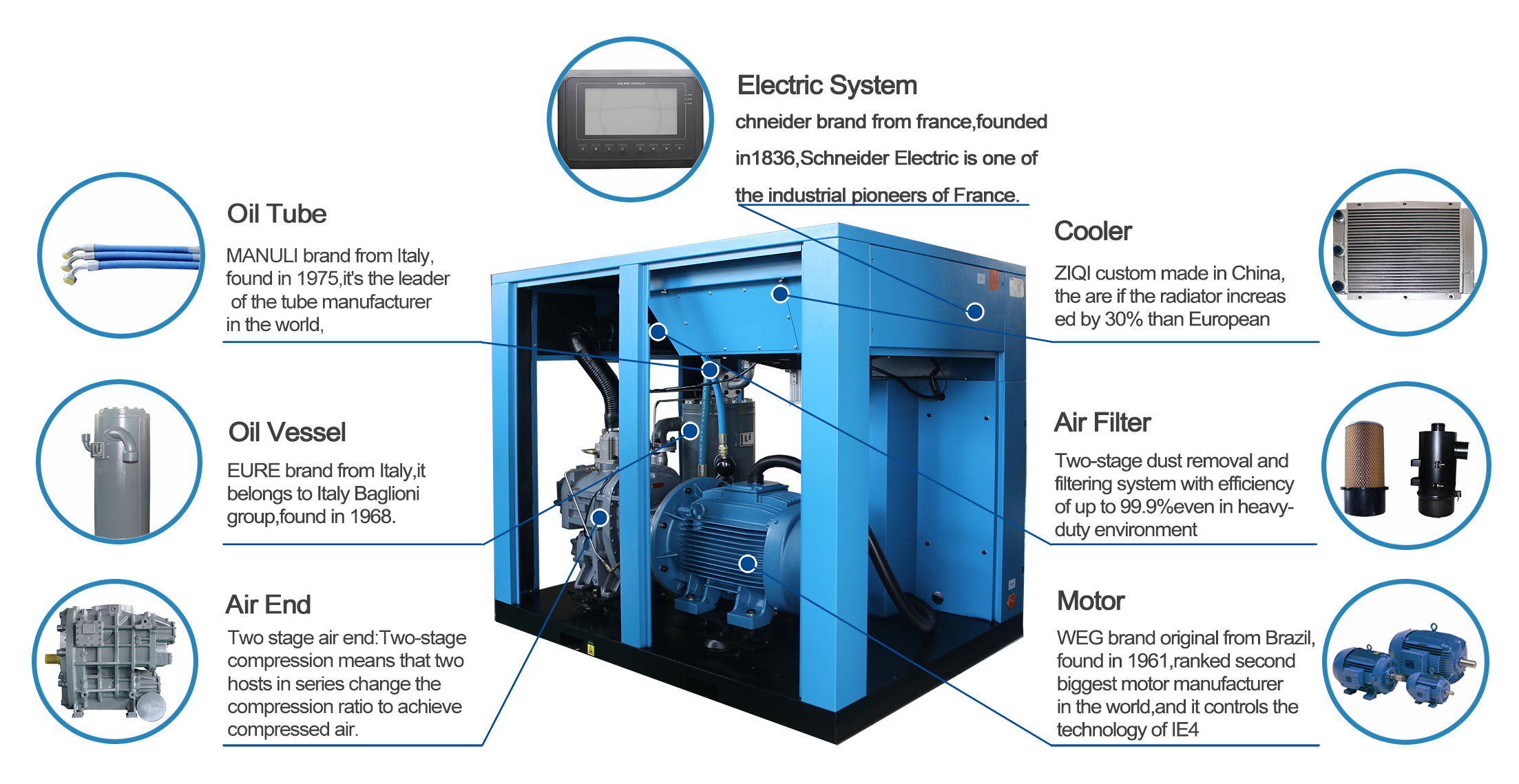
The air end determines specific power, which determines the electricity bill for the next decade. Ask for the air end's origin, its rotor profile generation, its bearing specification and whether the factory machines the rotors in-house or buys finished airends. A factory that buys finished airends has less freedom to change the compression element for your program, and that constrains what "OEM" can mean in practice.
The motor is the second line. Efficiency class, insulation class, service factor, bearing type and whether the motor is inverter-duty rated all belong in the specification, not in an email. A private-label machine sold on price usually carries an IE3 motor with a standard service factor; an OEM machine built for a brand that competes on uptime will specify more, and the quotation should show the delta as a separate line rather than buried in a lump sum.
Control philosophy is the third and most under-specified. Which controller, which parameter set, which remote-monitoring protocol, whether the controller firmware is locked, and whether you can read faults without the factory's software. On a private-label deal you will usually accept the factory's controller. On an OEM deal you should be specifying it, because the controller is what your service network will live with.
Factories are usually generous about cosmetic customisation and cautious about structural customisation, and that asymmetry is rational rather than stubborn. Cosmetic changes alter a work instruction. Structural changes alter a certification file, a test protocol and sometimes a pressure-vessel calculation.
| Change requested | Realistic in private label | Realistic in OEM | Why |
|---|---|---|---|
| Nameplate, colour, decals | Yes | Yes | Work-instruction level change |
| Manual, label language, packaging print | Yes | Yes | Documentation only |
| Controller language and parameter set | Usually | Yes | Needs a parameter review and a test run |
| Voltage and frequency variant | Often | Yes | Motor and starter change, re-test required |
| Receiver size or orientation | Rarely | Yes | Pressure-vessel calculation and certification follow the change |
| New canopy or frame | No | Yes, with tooling | New die, new general arrangement, new noise and thermal test |
| Different air end platform | No | Case by case | Changes specific power, footprint and the certification basis |
The practical rule for a first order is to customise everything cosmetic and nothing structural. Structural customisation belongs in the second or third order, once the buyer has a service history and a forecast against which the factory can amortise tooling.
A private-label programme is judged by the surfaces nobody itemises. The canopy and the nameplate are obvious. The following are the ones that arrive wrong on the first shipment: the controller overlay, the warning decals, the drain-valve label, the manual including the wiring diagram page, the declaration-of-conformity annex, the warranty card, the carton print, the pallet label, the QR code destination, the spare-parts list cover, and the digital nameplate if the controller exposes one.
Add the documents that travel separately from the machine: packing list, commercial invoice, certificate of origin, bill of lading, insurance certificate, and for regulated markets the conformity documents. A brand that appears on the canopy but not on the packing list creates a mismatch that a customs officer will resolve slowly and expensively.
Minimum order quantity is not a single number, it is a function of how many work instructions your order changes. A pure nameplate-and-colour change can run on a small batch because the line changes over in minutes. A new canopy die needs an amortisation volume, and a new receiver design needs a certification budget that no small batch can carry.
Two structuring options are worth knowing before you ask for a price. The first is a mixed container: several models under one brand, which reaches a sensible total volume while keeping per-model quantities low. The second is a staged programme where the first order is catalogue-standard and the tooling is amortised across a committed annual volume rather than the first shipment. Both are standard practice, and both need the volume commitment in writing. The mechanics of MOQ bands and the 60-day standard export lead time are set out in the MOQ and lead time guide, which is the right page to read next.
An OEM relationship is a decade-long service relationship disguised as a purchase order. The audit is therefore about capability and traceability, not about the showroom.
Do they machine rotors in-house, and can you see the rotor grinder and its calibration record?
Is there a test bench that measures flow, pressure and power together, and what is its calibration interval?
Welder qualification, vessel material certificates, and who signs the pressure test record.
Are bought-in motors and controllers inspected on receipt, and is the record retained per serial number?
From your serial number, can they produce the air end, the motor and the test sheet for that specific unit?
Is there a written process to notify you before a sub-supplier or a component changes?
Revision-controlled drawings and manuals, with your brand's documents kept in a folder you can audit.
Which parts are stocked for ten years, and what is the stated lead time for an air end exchange?
Who holds the CE file, the UL file and the PED assessment, and can you see the certificates rather than hear about them?
How many units per month are committed to your brand, and what happens to that slot in a peak season?
Point five is the one that separates a real OEM supplier from an assembler. If the factory cannot trace a delivered unit back to its air end and its test sheet, then your brand has no way to answer a warranty claim with evidence, and the claim becomes a negotiation instead of a repair.
Five clauses carry most of the value. Ownership of tooling and drawings, with a buy-back value and a handover deadline. Certificate responsibility, naming which party issues the DoC, which party holds the UL file and who pays for a brand addition. Change-notification, obliging the factory to inform you before a component or sub-supplier changes. Exclusivity, defined by territory and by model rather than by a general promise, because a general exclusivity clause is unenforceable in practice. And a warranty clause that states the remedy — part, unit or credit — rather than only the duration.
Two supporting clauses save disproportionate trouble. A spare-parts availability clause with a stated number of years and a stated maximum lead time. And an audit right, allowing you or a third party to inspect the production record for your units with reasonable notice, which is the mechanism that keeps a traceability commitment verifiable after year three.
The choice usually comes down to what the brand is selling. A brand selling a technical promise needs OEM, because it must own the specification it is defending. A brand selling availability and service needs ODM, because time to market matters more than the compression element. A distributor selling into a price-sensitive segment needs private label, because the lowest landed cost is the whole proposition.
There is a middle path that works well for first-time private-label buyers: start on an ODM platform, specify the controller parameters and the documentation, build a service history, then move to OEM tooling on the second generation once the failure modes and the spare-parts consumption are known. That sequence pays for the tooling out of operating experience rather than out of a forecast.
Whichever path is chosen, the same four questions decide whether the relationship survives: who owns the nameplate, who owns the drawings and tooling, who holds the certificate, and who carries the liability when an authority disagrees. Answer those in the contract and the commercial terms become a normal negotiation. Leave them unanswered and they become the dispute.
Send your target markets, the models you want to brand, your annual volume and which certificates you need to hold in your own name. Our export engineers will tell you which parts of the programme are feasible on a first order and which need tooling or a certification budget.
QUICK LINKS
PRODUCTS
CONTACT US
 Email : inquiry@ziqi-group.com
 Tel: +86-15026767628
 Add:Building 2, No. 205, Jianding Road, Fengjing Town, Jinshan District, Shanghai City.China
PLEASE CONTACT US.

ZIQI Compressor (Shanghai) Co., Ltd
Copyright © 2026 ZIQI Compressor (Shanghai) Co., Ltd - All rights reserved.

