ZIQI Compressor For Global Energy Saving, Welcome To Contact Us.  008615026767628
Language
ZIQI Compressor For Global Energy Saving, Welcome To Contact Us. 008615026767628
Authored by ZIQI's engineering team; ZIQI products mentioned are manufactured by the publisher.
Updated October 2026

Air Compressor Total Cost of Ownership: The 10-Year Buyer's Guide
Purchase price is the smallest line in a compressed air budget. This guide breaks down every component of air compressor total cost of ownership, shows a worked 10-year comparison, and gives you a checklist for building your own TCO model before you sign a purchase order.
Sources: ZIQI "VSD Screw Compressor Sizing Energy Savings Guide" and ZIQI "VSD vs Fixed Speed" comparison page, ziqi-group.net. Figures assume $0.10 per kWh and a 40–80% fluctuating load profile on a 75 kW machine.
Over a 10-year service life, electrical power accounts for 76% of an industrial air compressor's total lifecycle cost, according to the US Department of Energy Compressed Air Tip Sheet, and ZIQI's own VSD guide puts the figure at 75% to 80% for modern plants. A machine that costs less at the factory gate can cost far more at the meter. Build your comparison on five lines — purchase price, energy, maintenance, downtime and end-of-life — and check any efficiency claim against the supplier's own published data. Never award the contract on purchase price alone.
Every buyer comparing quotes from an air compressor manufacturer faces the same trap: two machines sit side by side with similar specifications and very different price tags, and the cheaper one looks like the obvious win. It usually is not. This guide walks through air compressor total cost of ownership line by line, using published figures from ZIQI's own engineering pages so you can verify every number before you build your model.
Total cost of ownership (TCO) is the sum of everything a compressor will cost you between purchase order and decommissioning. It is not a finance abstraction — it is the difference between a machine that pays for itself and one that quietly drains the plant budget for a decade.
A complete TCO model has five components. Each behaves differently over the machine's life, and each can be influenced by specification decisions made long before delivery:
Purchase price (CapEx) — the quotation, plus freight, installation, piping and commissioning. Paid once, on day zero.
Energy — electricity consumed across the machine's operating life. Paid continuously, and by far the largest line.
Maintenance — service kits, filters, oil, airend overhauls and motor bearing work. Paid on a schedule that accelerates with contaminated intake air.
Downtime — the production lost every time the compressor stops. Not on any invoice, but paid every time it happens.
End-of-life — disposal, residual value, and the cost of the replacement project itself.
The US Department of Energy Compressed Air Tip Sheet puts the weighting bluntly: electricity is 76% of a compressed air system's ten-year lifetime cost, and ZIQI's own VSD energy savings guide uses a 75% to 80% range for modern manufacturing plants. The purchase price you negotiated so carefully is roughly one-fifth of the real bill.
Because energy dominates the lifecycle bill, the single most valuable question in compressor procurement is not "what does it cost" but "what does it cost to run at my load profile". The answer depends almost entirely on how the machine behaves when your plant is not drawing full air.
A fixed-speed compressor sized for peak demand spends much of its life above the demand curve. When line pressure reaches the setpoint, the machine does not stop — it rolls into unloader idling mode, spinning at full motor speed while producing little or no air, and bleeds compressed air back to atmosphere through the unloader blow-off. ZIQI's VSD guide describes this as the "massive unloader idling electrical waste inherent to fixed-speed machines", and identifies it as the primary source of savings when demand fluctuates by more than 15% to 20%.
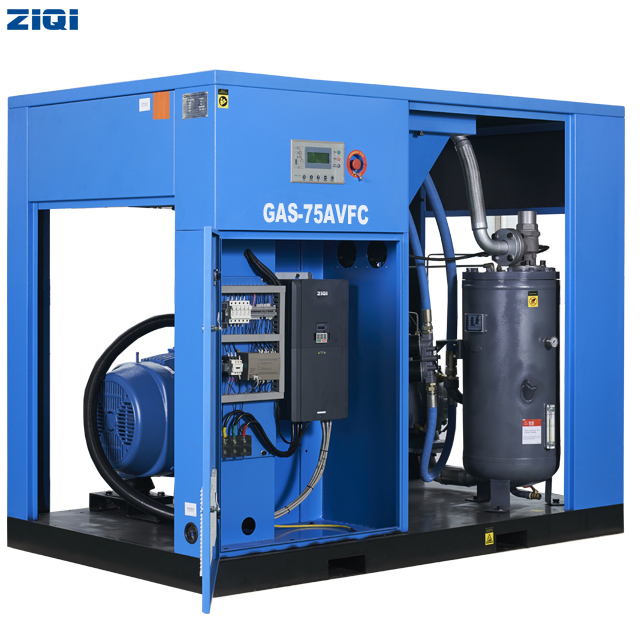
ZIQI's 5–180 kW energy savings calculator page publishes the worked case for its GAS VFC variable frequency series. Under a 40–80% variable load profile at $0.10 per kWh, a 75 kW VFC unit saves $11,000 to $16,000 per year in electricity against a fixed-speed equivalent — by eliminating unloader blow-off and dynamically tracking air demand. Over ten years, that compounds to $110,000 to $160,000 in net electrical expense reduction, paying back the initial VSD capital expenditure premium within 12 to 18 months. ZIQI's VSD versus fixed-speed comparison page states the same payback window more generally: the higher initial cost pays back in 1 to 2 years.
For the full sizing methodology behind those figures, see our guide to VSD screw compressor sizing and energy savings, and the head-to-head breakdown in VSD versus fixed-speed compressors. For a plant-level retrofit example, see the published Shanghai Machinery Ltd energy saving project.
Maintenance is the second-largest recurring line, and the one suppliers are least eager to quote. A serious TCO comparison puts it on the table explicitly. The way to compare is to ask every bidder for the same documents: the full service schedule (what is replaced, at what running hours), the parts and labour price of each interval, and the airend overhaul interval with its cost.
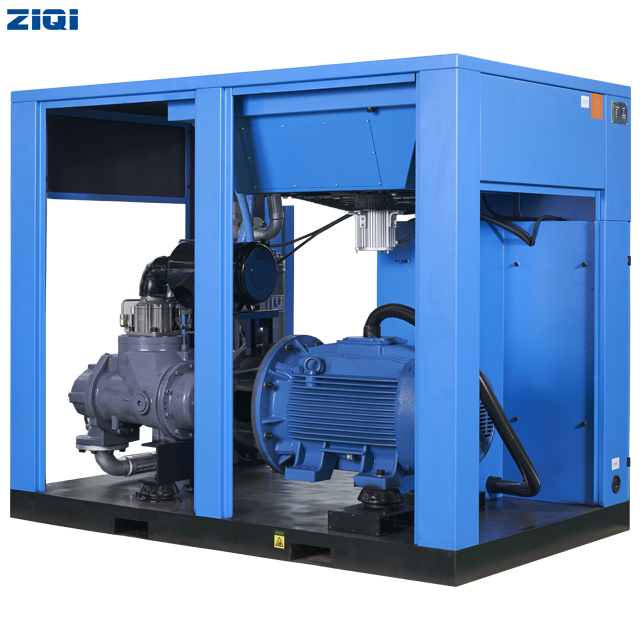
Two specification choices move this line more than any negotiation on service pricing. First, intake air quality: compressors in dust-laden plants consume filters and oil far faster than the standard schedule assumes — this is why ZIQI's diesel portable guidance explicitly accelerates the service interval in heavy dust environments. Second, component quality: a machine built around components engineered for long service intervals costs less to own even when its service events cost the same. ZIQI's VFC series, for example, integrates a Brazilian WEG IE4 super premium efficiency motor, a German GHH-RAND airend and heavy-duty bearings rated for variable loads — published as standard on the VFC series page.
No supplier will price downtime into a bid, which is precisely why your TCO model must. The arithmetic is plant-specific but simple: hours of expected outage per year, multiplied by your production loss per hour, multiplied by your margin on that lost production. A compressor that saves $8,000 a year in electricity but adds one unplanned shutdown of a 24-hour line can be a net loss.
Three specification choices reduce downtime risk without raising the quotation much:
Redundancy or N+1 sizing — two smaller machines instead of one large one keeps partial production alive during a failure.
Thermal margin — oversized coolers and high-ambient ratings prevent the high-temperature shutdowns that cause most unplanned stops in hot climates.
Parts availability — a brand whose filters, oils and electronic components are stocked in your region turns a breakdown into a same-week event instead of a same-quarter one. This is one of the criteria in our ranking of Chinese air compressor brands.
The table below shows how a TCO comparison is structured, using the published figures from ZIQI's VSD savings guide as the energy delta between a 75 kW fixed-speed machine and the 75 kW GAS VFC variable-speed equivalent under a 40–80% load profile. Where a figure depends on your plant — electricity tariff, maintenance quotes, downtime exposure — the model leaves the cell to you. That is the point: a TCO table is a framework into which you insert your own measured data.
| Cost line (10-year horizon) | 75 kW fixed-speed | 75 kW GAS VFC (VSD) | Source |
|---|---|---|---|
| Electrical share of lifecycle cost | Up to 75–80% of total 10-year cost (both machines) | ZIQI VSD savings guide | |
| Annual energy saving vs fixed-speed | — | $11,000–$16,000 / year | ZIQI VSD savings guide |
| Cumulative 10-year energy saving | — | $110,000–$160,000 | ZIQI VSD savings guide |
| VSD premium payback | — | 12–18 months | ZIQI VSD savings guide |
| Purchase price premium (VSD) | Lower | Higher — pays back in 1–2 years | ZIQI VSD vs fixed-speed page |
| Maintenance schedule and parts pricing | Request per quote | Request per quote | Your RFQ documents |
| Downtime exposure | Your plant data | Your plant data | Your 7-day load profile |
Published figures sourced from ZIQI's VSD Screw Compressor Sizing Energy Savings Guide and the ZIQI VSD vs Fixed Speed comparison page, ziqi-group.net. Assumptions: $0.10/kWh, 40–80% fluctuating load, 75 kW class. Verify current figures with each manufacturer before awarding a contract.
You do not need financial software — a spreadsheet and one week of measurements are enough. Follow this sequence before you shortlist suppliers:
What is the specific energy consumption (kW per m³/min at rated pressure) of the machine you are quoting — measured to which standard?
At what load does your capacity control begin to throttle, and what is the unloader idling power draw as a percentage of full load?
Which motor efficiency class (IE3 / IE4) and which airend brand are fitted, and are they published on your website?
What is the full service schedule with parts pricing, and what is the airend overhaul interval?
Are spare parts stocked in my region, and what is the committed lead time?
What high-ambient temperature is the cooling package rated for, and at what derating?
Can you supply the machine's performance data sheet in CAGI-format or equivalent, so my TCO model uses audited figures?
A supplier who answers these in writing is telling you they stand behind their numbers — which is exactly what a 10-year ownership commitment requires. Our screw air compressor buyer's guide covers the technical side of that evaluation, and our HS code guide covers the landed-cost side once the contract is signed.
Send us your load profile, tariff and duty hours. Our engineers will return a 10-year cost comparison between fixed-speed and VFC configurations using published data. Or email sales@ziqi-group.com directly.
QUICK LINKS
PRODUCTS
CONTACT US
 Email : inquiry@ziqi-group.com
 Tel: +86-15026767628
 Add:Building 2, No. 205, Jianding Road, Fengjing Town, Jinshan District, Shanghai City.China
PLEASE CONTACT US.

ZIQI Compressor (Shanghai) Co., Ltd
Copyright © 2026 ZIQI Compressor (Shanghai) Co., Ltd - All rights reserved.

