ZIQI Compressor For Global Energy Saving, Welcome To Contact Us.  008615026767628
Language
ZIQI Compressor For Global Energy Saving, Welcome To Contact Us. 008615026767628

Field Engineer
ZIQI Compressor Group · Updated October 2026
Five compressor families, one decision: match the type to your flow, pressure, duty cycle and air-quality requirement before you compare price.
Published by ZIQI Compressor Group, which manufactures the products discussed in this guide.
65-78%
isentropic efficiency, oil-injected rotary screw
Source: HVAC Laboratory compressor types review
80-85%
isentropic efficiency, three-stage centrifugal
Source: HVAC Laboratory compressor types review
53-65 dB(A)
sound pressure level, oil-free scroll package
Source: Adaptive Air scroll compressor range
76%
energy share of lifetime operating cost
Source: NRCan and US DOE compressed air guide
Almost every industrial air compressor sold today belongs to one of five families: rotary screw, reciprocating (piston), scroll, rotary vane and centrifugal. They differ in how the air is squeezed, and that mechanical difference decides the flow, pressure, duty cycle and air quality each family can hold. ZIQI is an air compressor manufacturer established in 2007, and its range covers three of the five families, so the comparison below is written to help a buyer eliminate options rather than to defend one technology.
The table uses published capacity, pressure and isentropic efficiency bands. Read it as a screening tool: any family whose band excludes your duty is out before you ever compare price. The capacity figures are free air delivery at the machine outlet, the same basis used in acceptance testing under ISO 1217. Source: HVAC Laboratory compressor types review, which compiles the published CAGI efficiency and capacity bands.
| Family | Typical capacity (m³/min) | Pressure (bar) | Isentropic efficiency | Where it fits | Source |
|---|---|---|---|---|---|
| Reciprocating, single stage | 0.1-30 | 1-10 | 75-85% | Intermittent duty, low first cost | HVAC Laboratory |
| Reciprocating, two stage intercooled | 0.2-50 | 7-35 | 85-93% | High pressure, high efficiency | HVAC Laboratory |
| Oil-injected rotary screw | 1-60 | 4-14 | 65-78% | Continuous plant air | HVAC Laboratory |
| Oil-free rotary screw, two stage | 5-150 | 7-10 | 70-80% | Clean air at larger flow | HVAC Laboratory |
| Scroll | 0.2-5 | 3-10 | 60-75% | Quiet, small capacity, oil-free | HVAC Laboratory |
| Rotary vane | 0.1-20 | 4-10 | 60-75% | Low-cost workshop air | HVAC Laboratory |
| Centrifugal, three stage | 30-1000+ | 7-20 | 80-85% | Large constant base load | HVAC Laboratory |
Two conclusions follow directly from that table. First, the families overlap only in narrow windows, so the choice is usually settled by flow and pressure before efficiency is ever discussed. Second, efficiency is not one number: a two-stage reciprocating machine at 85 to 93 percent beats an oil-injected screw at 65 to 78 percent, which is why the sentence "screw is more efficient" only holds inside a given family and a given duty.
A rotary screw compressor traps air between two intermeshing helical rotors. As the rotors turn, the trapped volume shrinks and moves toward the discharge port, producing a continuous, pulse-free flow. Because the rotors never stop and the oil film carries heat away from the compression chamber, the machine is built for a 100 percent duty cycle and can run around the clock without a cool-down interval.
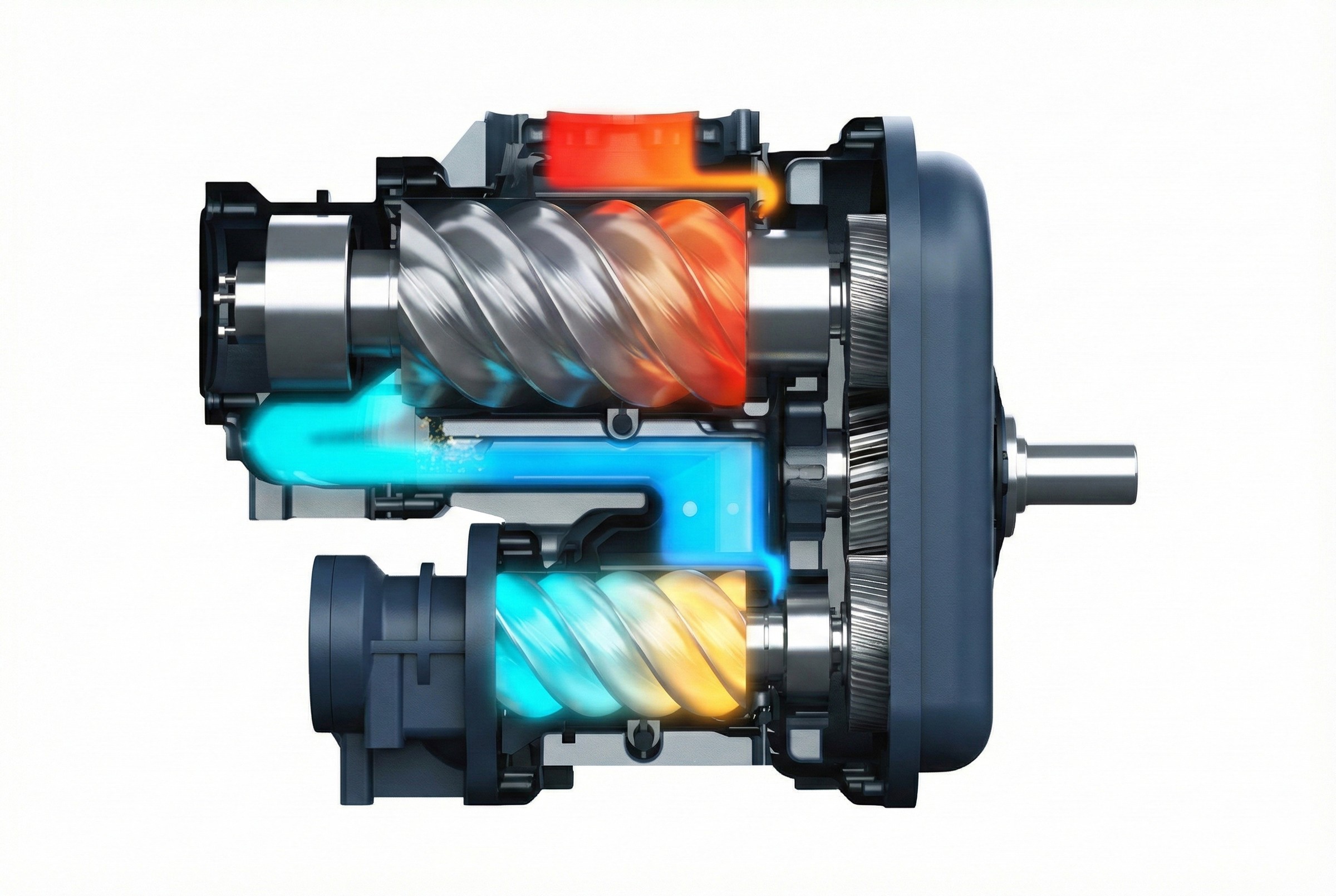
The family spans roughly 1 to 60 m³/min at 4 to 14 bar for the oil-injected version, and up to 150 m³/min for a two-stage oil-free version at 7 to 10 bar. That breadth is why the screw has become the default for plant air: one family can serve a workshop drawing 2 m³/min and a factory drawing 40 m³/min without changing technology. Source: HVAC Laboratory compressor types review.
Where the screw disappoints is at the edges. Below about 1 m³/min a small piston or scroll unit is simpler and cheaper. Above about 60 m³/min the number of screw packages needed starts to count against it, and a centrifugal machine becomes the more sensible shape for a steady load. And when demand swings widely, a fixed-speed screw cycling between load and unload wastes energy, which is why the fixed speed versus VSD comparison matters as much as the family choice itself.
A reciprocating compressor draws air into a cylinder, closes the inlet valve and pushes a piston through the trapped volume, then discharges through an outlet valve. The work happens in discrete strokes, so the air arrives in pulses rather than a steady stream, and the crankshaft has to convert rotation into reciprocation, which is the origin of the vibration that defines the family.
Single-stage machines cover roughly 0.1 to 30 m³/min at 1 to 10 bar with 75 to 85 percent isentropic efficiency. Adding a second stage with an intercooler between the cylinders pushes pressure into the 7 to 35 bar band and lifts efficiency to 85 to 93 percent, which makes the two-stage piston the most efficient of the five families per unit of energy at high pressure. Source for both bands: HVAC Laboratory compressor types review.
The limit is thermal, not mechanical. Reciprocating compressors are typically rated for a 50 to 75 percent duty cycle and need rest periods to shed heat; running one continuously overheats valves and rings and shortens the life of both. That single constraint is what pushes a buyer with long running hours toward a screw, even where the piston is more efficient on paper. The duty-cycle rating is documented in the Anglian Compressors duty-cycle guide.
A scroll compressor uses two interleaved spiral elements, one fixed and one orbiting inside it. Air is trapped at the outer edge, carried inward and compressed as the pocket shrinks toward the centre, where it is discharged. Nothing reciprocates and nothing rubs, so the compression chamber needs no oil at all and the machine produces oil-free air by design rather than by filtration.
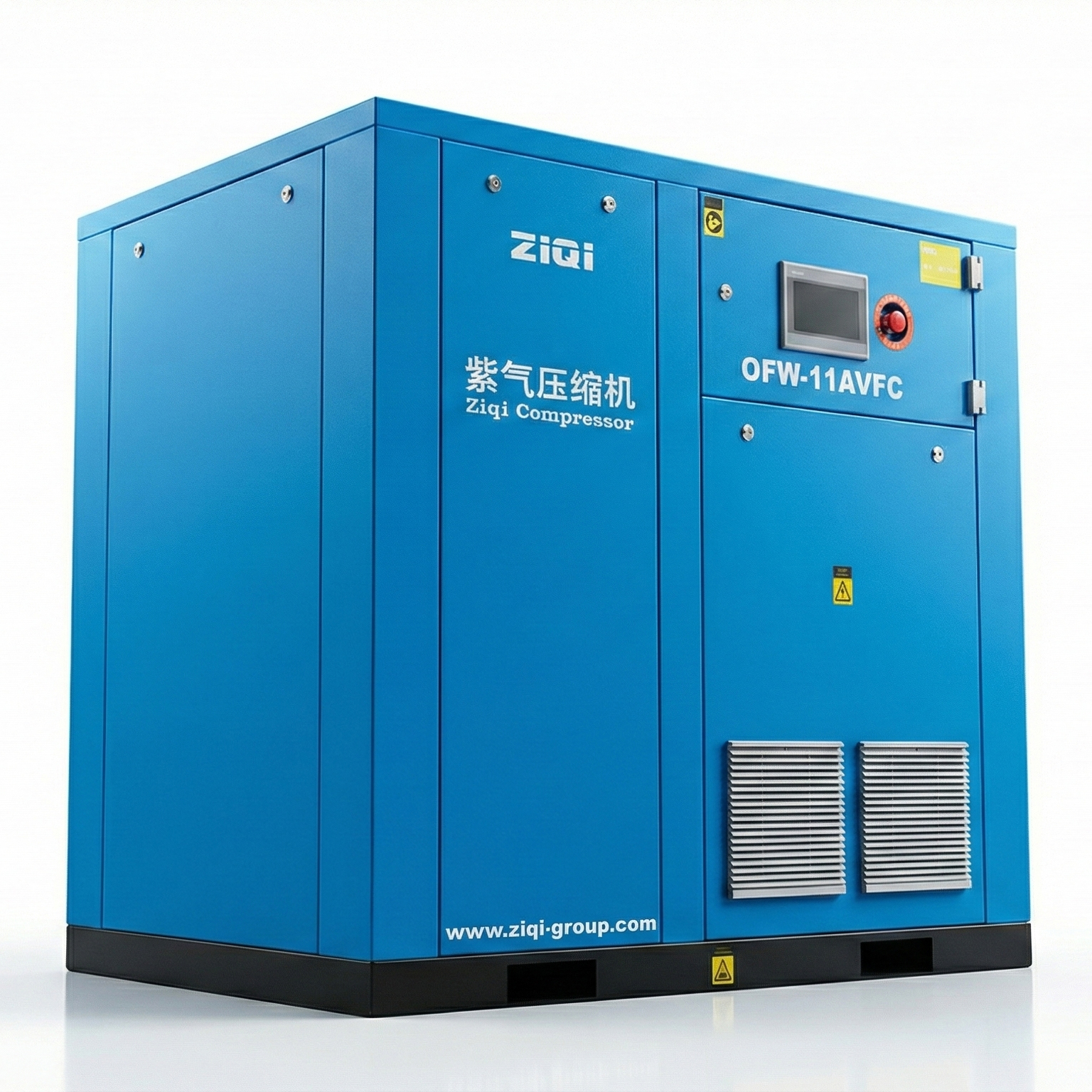
Capacity runs from about 0.2 to 5 m³/min at 3 to 10 bar, and the published sound pressure for oil-free scroll packages is 53 to 65 dB(A), which is quiet enough to sit in a laboratory, a dental surgery or a clean assembly area without hearing protection. Source: Adaptive Air oil-free scroll compressor range data. Sealing is done by tip strips on the scroll faces rather than by an oil film, and those strips are a wear item, replaced on an interval rather than a calendar.
The usual trap is scale. Below roughly 40 kW, an oil-free scroll is often the better answer than an oil-free screw because the screw costs more and runs louder for no gain in air quality. Above that size the scroll has no advantage, and the oil-free screw or a centrifugal machine takes over. Multi-element scroll packages also stage individual elements on and off to follow demand, which gives a cleaner turn-down than a single large machine idling.
A rotary vane compressor runs a rotor with sliding blades inside an eccentric casing. Centrifugal force presses the blades against the casing wall, and the spaces between adjacent blades shrink as the rotor turns, compressing the trapped air. The design has few moving parts, balances well and produces a smooth discharge, which is why it appears in small workshop and automotive duty.
Published bands put rotary vane at roughly 0.1 to 20 m³/min, 4 to 10 bar and 60 to 75 percent isentropic efficiency. Source: HVAC Laboratory compressor types review. The efficiency sits at the low end of the five families, so the vane wins on first cost and footprint rather than on running cost. Blade wear is a normal maintenance item, and the blade-to-casing clearance is what governs how much efficiency is left after a few thousand hours of service. Oil carry-over also has to be handled by filtration if the air touches product, so a vane is rarely the right choice for food, pharmaceutical or breathing-air duty.
A centrifugal compressor accelerates air with a rotating impeller and then converts that velocity into pressure in a diffuser. Each stage contributes a limited pressure ratio, so industrial air machines are built with two or three stages and an intercooler between them. There is no oil in the compression path at all, so oil-free air is a property of the design rather than an add-on.
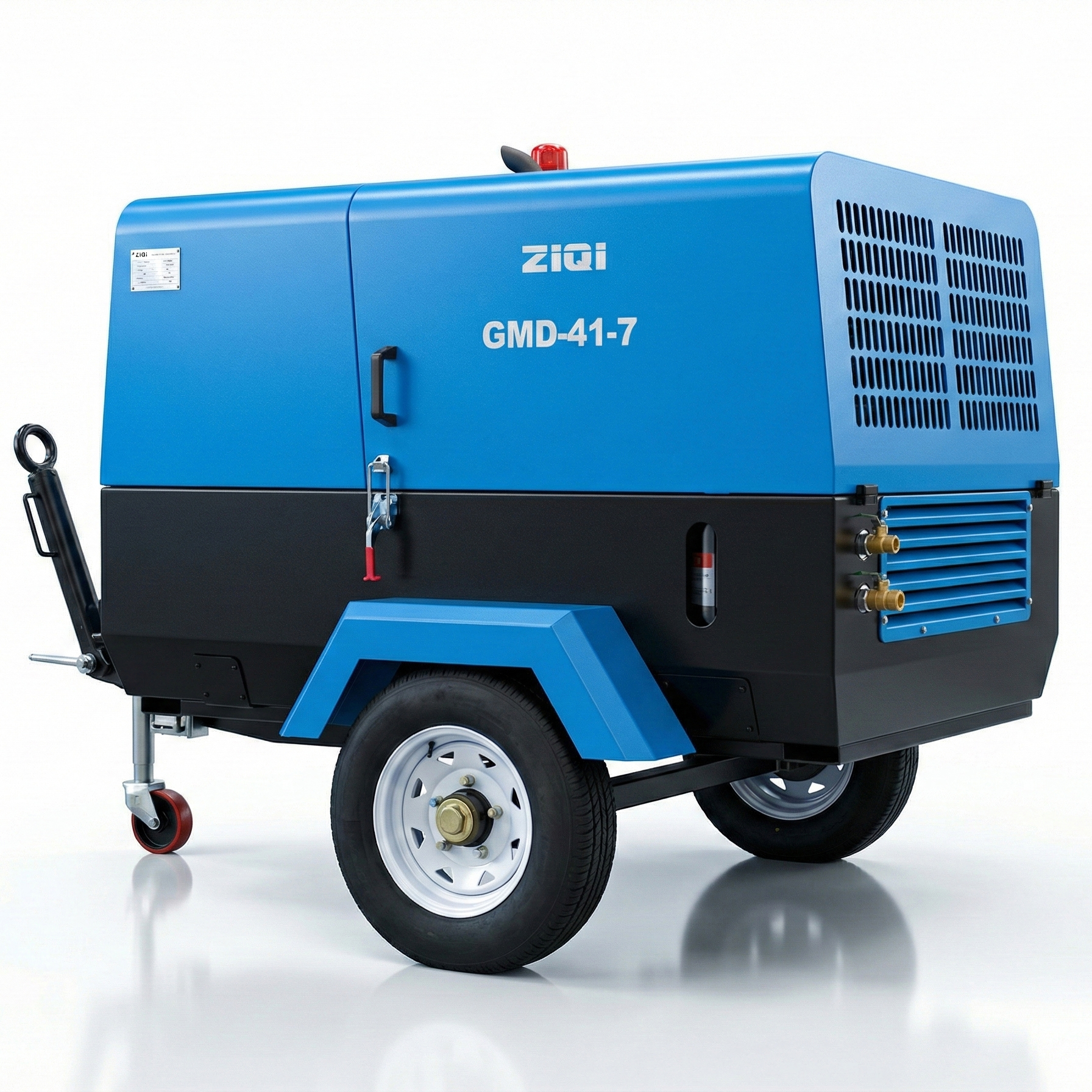
The family starts where the others run out: roughly 30 to 1,000 m³/min at 7 to 20 bar, with 80 to 85 percent isentropic efficiency for a three-stage intercooled machine. Source: HVAC Laboratory compressor types review. That efficiency figure is the best of the five families at high flow, and it is why a plant with a large, steady base load usually ends up with a centrifugal machine at the centre of its air system.
Two behaviours need to be designed around. First, a centrifugal machine has a surge limit: below a minimum flow the machine becomes unstable, so the control system has to protect against it with inlet guide vanes, a blow-off valve or a bypass. Second, part-load behaviour is poor compared with a screw on a variable speed drive, so a centrifugal is chosen for the base load and a screw trims the swings. Published noise for centrifugal air compressors sits around 70 to 90 dB(A), noticeably louder than a scroll and comparable to a piston. Source: Acvatron centrifugal compressor specification data.
The point of a screening table is to remove options, not to rank them. The example below works through a plant that needs 45 m³/min at 8 bar, with a demand that varies through the shift. Every capacity and pressure band used in the screening comes from the source table above; the running hours are assumed for this example and are not a site measurement.
Screening a 45 m³/min duty at 8 bar
Given: 45 m³/min free air delivery at 8 bar, air must be oil-free, demand varies through the shift, and the plant runs an assumed 6,000 hours annually.
Step 1, convert the flow. 45 m³/min × 35.3147 = 1,589 cfm, so the requirement is stated on the same basis as a US catalogue.
Step 2, screen by capacity. Scroll stops at 5 m³/min, rotary vane at 20 m³/min, single-stage reciprocating at 30 m³/min. All three are out before pressure is considered.
Step 3, screen by pressure. Oil-injected screw (4-14 bar), oil-free two-stage screw (7-10 bar), two-stage reciprocating (7-35 bar) and three-stage centrifugal (7-20 bar) all pass 8 bar.
Step 4, screen by air quality. The oil-free requirement removes the oil-injected screw, leaving oil-free two-stage screw, two-stage reciprocating and three-stage centrifugal.
Step 5, screen by duty. 6,000 hours annually is continuous operation, and a reciprocating machine is rated for a 50 to 75 percent duty cycle with rest periods, so it drops out even though its efficiency band looks attractive.
Result: two candidates remain, an oil-free two-stage screw and a three-stage centrifugal. The tie-break is load stability rather than efficiency: a varying load favours the screw, and a flat base load above 30 m³/min favours the centrifugal.
Source for every band applied in steps 2 to 5: HVAC Laboratory compressor types review. Source for the duty-cycle rating in step 5: Anglian Compressors duty-cycle guide.
That sequence is the whole method. Capacity and pressure eliminate most of the field, air quality removes another slice, duty cycle removes the machines that would be run outside their rating, and only then does efficiency decide between the survivors.
Choosing a family decides more than the compressor. A reciprocating machine delivers air in pulses, so the receiver has to be sized to absorb them; a screw delivers a steady stream and needs a smaller buffer for the same tools. A centrifugal machine needs surge protection in its control system, which is a cost the other families do not carry.
Air quality decides the treatment train. An oil-free scroll or centrifugal machine removes the need for coalescing filters, while an oil-injected screw needs them plus a drain strategy. A piston or vane machine has oil carry-over that has to be intercepted before the air reaches a dryer, or the desiccant bed is contaminated. The oil-free versus oil-flooded comparison sets out what that decision costs in filtration and monitoring.
Pressure level decides how many stages you need, and stages decide part-load behaviour. Where the duty sits above about 20 bar, the two-stage reciprocating machine is the efficient answer and the two-stage versus single-stage comparison explains the intercooling benefit that produces it.
Comparing families on efficiency alone. A piston machine can be more efficient than a screw and still be the wrong choice, because a 65 percent duty cycle cannot serve a plant that runs three shifts. Instead: screen by capacity, pressure and duty before you read any efficiency figure.
Assuming oil-free means the same thing in every family. In a scroll or centrifugal machine oil-free is structural; in a screw it depends on whether the compression chamber is injected. Two machines both described as oil-free can carry very different filtration requirements. Instead: ask which part of the machine the oil touches, not just which label is used.
Sizing on peak flow instead of simultaneous demand. Peak flow is a moment; a compressor is sized on the sum of what runs at the same time. Oversizing a piston unit makes it short-cycle and never reach operating temperature. Instead: add the simultaneous demand, then add a margin for leakage and future load.
Buying on the lowest purchase price for a continuous duty. Energy is the dominant line in a compressor's lifetime cost, so a low first cost on a machine that runs the 6,000 hours assumed in the example above is a small saving against a large recurring bill. Source for the energy share: the NRCan and US DOE compressed air guide cited in the stat block. Instead: put energy, maintenance and capital on the same multi-year horizon before choosing.
Convert everything to free air delivery at the discharge, and note the pressure at which it is quoted.
Cross out every family whose published band excludes your duty. Most projects lose three of the five families at this step.
Oil-free by design removes the oil-injected screw from the shortlist; if oil is acceptable, it stays in.
A 50 to 75 percent duty machine cannot serve continuous operation. Convert hours per day into hours per year first.
A flat base load and a swinging load point to different families even when flow and pressure are identical.
Receiver, dryer and filters follow from the family and the air quality. Budget them together, not afterwards.
Run those six steps and the shortlist is usually two machines. At that point the decision is about service access, spare-part availability and the load profile, not about which technology sounds more modern.
If the shortlist has narrowed to two screw machines, the screw air compressor buyers guide walks through reading a quotation line by line. If the question is screw against piston specifically, the screw versus piston comparison goes deeper on duty cycle and total cost. And if the duty is so large that a dynamic machine is in scope, the centrifugal versus axial comparison explains where the two dynamic families diverge.
Send your pressure, flow, running hours and air-quality requirement, and our engineers will tell you which families are even in scope before a quotation is written.
QUICK LINKS
PRODUCTS
CONTACT US
 Email : inquiry@ziqi-group.com
 Tel: +86-15026767628
 Add:Building 2, No. 205, Jianding Road, Fengjing Town, Jinshan District, Shanghai City.China
PLEASE CONTACT US.

ZIQI Compressor (Shanghai) Co., Ltd
Copyright © 2026 ZIQI Compressor (Shanghai) Co., Ltd - All rights reserved.

