ZIQI Compressor For Global Energy Saving, Welcome To Contact Us.  008615026767628
Language
ZIQI Compressor For Global Energy Saving, Welcome To Contact Us. 008615026767628
The difference between export-grade and domestic-grade Chinese air compressors is not brand name, factory size, or marketing language — it is four internal components. Export-grade machines use a named international airend (GHH-RAND or Rotorcomp) with a traceable serial number, a WEG IE4 motor with confirmed pure copper windings, 304 stainless steel internal piping, and an open-architecture Siemens or Schneider controller. Domestic-grade machines use domestic airends, IE3 motors, carbon steel piping, and proprietary controllers — specifications optimised for China's domestic price market, not for 24/7 export industrial use. Over 10 years on a 75kW unit, this component gap produces a $30,000–$60,000 total cost difference.
"Export grade" is one of the most overused terms in the Chinese manufacturing market. Every supplier on Alibaba claims it. Product photos look identical. Specification sheets list the same rated pressure, flow, and power. The only way to know whether a machine is genuinely export-grade is to look at the four components that the specification sheet never mentions — and ask for written documentation for each one before signing the purchase order.
This guide explains exactly what separates export-grade from domestic-grade at the component level, what the cost difference looks like in real numbers, and how to verify which grade you are actually buying.
The common assumption is that export-grade simply means "more expensive" or "from a well-known brand." Neither is reliable. A domestic-grade machine from a major Chinese brand can cost more than an export-grade machine from a smaller specialist manufacturer. And brand recognition in China's domestic market reflects domestic sales volume — not component specification.
The distinction is entirely component-based. A Chinese-assembled compressor is export-grade if and only if it uses:
Domestic airend — undisclosed manufacturer, wider tolerances
IE3 induction motor — standard efficiency, often with aluminum or CCA windings
Carbon steel or galvanized internal piping — corrodes within 3–5 years
Proprietary controller — OEM service required for all diagnostics
Component documentation: brochure claims only
Named international airend (GHH-RAND / Rotorcomp) — traceable serial number
IE4 motor (WEG or equivalent) — pure copper windings, third-party certificate
304 Stainless Steel internal piping — no corrosion for machine's full service life
Open-architecture controller (Siemens / Schneider) — any technician globally can service
Component documentation: 4 third-party verifiable certificates
The airend is the compression element — the component that does the actual work of compressing air. It accounts for 40–60% of a compressor's long-term performance and service cost. Export-grade machines use airends from named international manufacturers with documented rotor tolerances and traceable serial numbers. Domestic-grade machines use undisclosed domestic airends.
| Specification | Export Grade (GHH-RAND) | Domestic Grade |
|---|---|---|
| Rotor tolerance | ±2–5 microns | ±10–20 microns (typical) |
| Volumetric efficiency | >95% — maintained over service life | 85–92% — degrades faster with wider tolerances |
| Bearing L10 rating | 40,000–60,000 hours | 15,000–25,000 hours (typical) |
| Traceability | Serial number verifiable directly with GHH-RAND | No traceable origin — manufacturer undisclosed |
| 10-year efficiency cost impact (75kW) | Stable output, stable electricity cost | +$10,000–$15,000 from efficiency degradation |
For a complete guide on how to verify airend origin before purchase, see our GHH-RAND airend verification guide.
The motor efficiency gap between export-grade (IE4) and domestic-grade (IE3) produces the single largest annual cost difference between the two specifications. On a 75kW compressor running 6,000 hours/year at $0.12/kWh:
| Motor Specification | Annual Electricity (75kW, 6,000h, $0.12/kWh) | Annual Saving vs IE3 |
|---|---|---|
| IE3 Fixed Speed (domestic grade) | $54,000/year | Baseline |
| IE4 PM VSD (export grade) | $33,480/year | $20,520/year |
Beyond efficiency class, export-grade motors use 100% pure copper windings — confirmed by a separate third-party winding material test report. Domestic-grade machines frequently use copper-clad aluminum (CCA) windings, which look identical externally but conduct 30% less effectively, run 15–25°C hotter, and degrade faster under sustained compressor load.
For the full breakdown of IE4 vs IE3 savings across three operating scenarios, see our IE4 vs IE3 real cost difference guide.
This is the component difference that most buyers discover only after 3–5 years of operation. Domestic-grade machines use galvanized carbon steel internal piping throughout the oil and air circuit. Export-grade machines use 304 stainless steel.
Carbon steel piping corrodes from the inside under the moisture and oil vapor present in normal compressor operation. The rust particles shed from corroding pipes do three things simultaneously:
Contaminate the compressor oil, accelerating oxidation and reducing lubrication quality
Clog the oil scavenge line, causing oil to accumulate in the separator and pass into the air stream
Abrade and prematurely saturate the oil separator element, reducing service intervals from 3–4 years to 6–12 months
The result is a machine that appears to function normally but requires separator element replacement two to three times more frequently than its rated service interval — and develops chronic oil-in-air complaints that standard maintenance procedures temporarily resolve but cannot permanently fix. 304 stainless steel piping eliminates this failure mode entirely for the machine's full service life.
Domestic-grade machines use proprietary controllers that require the original manufacturer's software and trained personnel for all service operations — including routine service interval resets after maintenance. In China, where the manufacturer has a service network, this is manageable. In export markets — Southeast Asia, Africa, the Middle East, Latin America — a proprietary controller fault can mean days of unplanned downtime waiting for OEM support.
Export-grade machines use Siemens or Schneider Electric open-architecture controllers. Any qualified automation technician globally can diagnose faults, reset service counters, and access operational data without OEM software or authorisation. This is not a minor convenience difference — it is a fundamental service independence that determines total maintenance cost and uptime reliability over the machine's service life in non-China markets.
The following calculation compares a domestic-grade 75kW compressor (IE3 fixed speed, domestic airend, carbon steel piping, proprietary controller) against an export-grade 75kW unit (IE4 PM VSD, GHH-RAND airend, 304SS piping, open controller). Assumptions: 6,000 operating hours/year, $0.12/kWh electricity.
The challenge is that domestic-grade and export-grade machines look identical from the outside. Product photos, specification sheets, and marketing materials do not reveal component grade. The only reliable verification method is written documentation for each of the four components.
Request these four documents from any Chinese compressor supplier before placing an order. Provide them before — not after — the purchase order is signed:
Airend origin certificate + serial number — specifically naming the airend manufacturer (GHH-RAND, Rotorcomp, or equivalent) with a serial number that can be cross-referenced directly with the airend manufacturer. "German technology" without a manufacturer name and serial number is not verification. See our complete airend verification guide.
IE4 motor efficiency certificate (IEC 60034-30-1) — from the motor manufacturer, specifying the motor model and measured full-load efficiency class. This must be a separate document from the winding material certificate.
Motor winding material test report — a third-party test confirming 100% pure copper content. An IE4 nameplate does not confirm winding material. Copper-clad aluminum (CCA) windings are visually identical and will not appear on a general IE4 certificate.
Controller brand confirmation — written confirmation that the controller uses Siemens or Schneider Electric components, and that third-party technicians can service it without OEM software. A supplier who cannot confirm this in writing uses a proprietary domestic controller.
A genuine export-grade Chinese compressor manufacturer provides all four documents within 24 hours — before any deposit is requested. For a full guide on evaluating Chinese manufacturers using this framework, see our guide on how to find a reliable air compressor manufacturer in China.
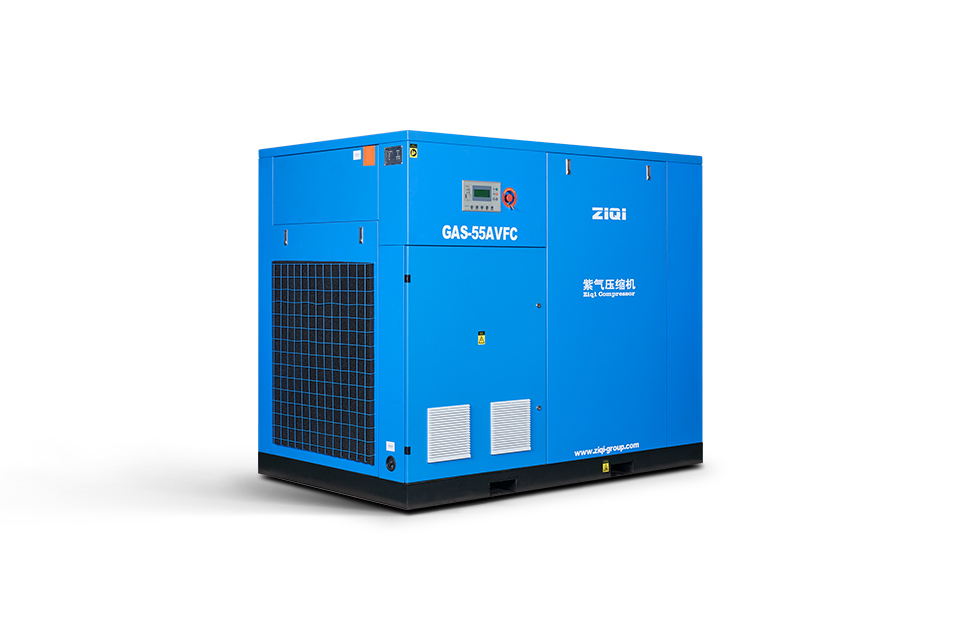
ZIQI Compressor Group (紫气压缩机) export-grade unit. All four components — GHH-RAND airend, WEG IE4 motor, 304SS piping, Siemens/Schneider controller — documented by third-party certificates supplied with every unit.
GHH-RAND airend serial number + origin certificate, WEG IE4 efficiency certificate, copper winding test report, Siemens/Schneider controller confirmation — all four within 24 hours, before any deposit.
Domestic-grade machines are not unsuitable for every application. The choice depends on three factors: operating hours per year, location of the installation, and whether the application has air quality requirements.
| Application Profile | Domestic Grade Acceptable? | Reason |
|---|---|---|
| General factory use, 8h/day, domestic China, Kaishan service available | ✅ Acceptable | Low operating hours reduce electricity gap; local service network mitigates controller risk |
| 24/7 production, any location | ❌ Not recommended | $20,520/year electricity gap on 75kW; proprietary controller creates service risk at all hours |
| Export market installation (outside China) | ❌ Not recommended | Proprietary controller creates OEM dependency with no local service network; carbon steel piping creates corrosion issues without Chinese-standard maintenance intervals |
| Food, pharma, or electronics application | ❌ Not recommended | Corroding carbon steel internal piping introduces rust contamination into air stream independently of oil-free status; see our guide on oil-free compressors for food processing |
| 24/7 in country without manufacturer's service network | ❌ Not recommended | Proprietary controller failure = unplanned downtime waiting for OEM support; no local technician can resolve software-locked faults |
The difference is four internal components — not price, brand name, or country of assembly. Export-grade Chinese compressors use a named international airend manufacturer (GHH-RAND or Rotorcomp) with a traceable serial number, a WEG or equivalent IE4 motor with confirmed pure copper windings, 304 stainless steel internal piping throughout the oil and air circuit, and an open-architecture controller from Siemens or Schneider Electric that any qualified technician can service globally. Domestic-grade machines use undisclosed domestic airends, IE3 motors (often with copper-clad aluminum windings), carbon steel piping that corrodes within 3–5 years, and proprietary controllers requiring OEM service involvement. The 10-year total cost difference on a 75kW unit running 6,000 hours/year is $30,000–$60,000, primarily driven by electricity savings from IE4 vs IE3 specification.
The upfront price premium for a genuine export-grade Chinese compressor over a domestic-grade equivalent is typically $6,000–$10,000 on a 75kW unit. This premium is recovered through electricity savings alone within 4–6 months on a 24/7 production line — the IE4 PM VSD motor saves $20,520/year versus IE3 fixed speed on that unit. Over 10 years, the export-grade machine costs $30,000–$60,000 less in total — making the upfront premium effectively negative on any installation running more than 3,000 hours per year.
In most cases, no — not economically. The four components that define export grade (airend, motor, internal piping, controller) are fundamental to the machine's architecture. Replacing the airend requires disassembling the entire compression block. Replacing internal piping requires stripping the cabinet. Replacing a proprietary controller with an open-architecture Siemens or Schneider system requires complete rewiring and programming. The combined cost of these modifications typically exceeds the price difference between a domestic-grade and export-grade machine purchased new. It is substantially more cost-effective to specify export grade at the time of purchase.
At the component level, a genuine export-grade Chinese compressor uses components from the same global supply chain as Atlas Copco and Kaeser machines. GHH-RAND airends are found in Kaeser and CompAir machines. WEG IE4 motors are used by Atlas Copco. 304 stainless steel piping is standard on both European brands. Siemens and Schneider Electric controllers are found in Kaeser and some Atlas Copco models. The component specifications are equivalent. The differences between export-grade Chinese and premium European machines are: (1) service network density in established European markets, (2) Atlas Copco's proprietary Elektronikon software integration, and (3) brand recognition with end clients. On core mechanical performance over a 10-year service life, a properly specified export-grade Chinese compressor delivers equivalent output at 40–60% lower purchase cost.
Carbon steel internal piping corrodes under normal compressor operating conditions within 3–5 years. In China, where service intervals are frequent and technicians are close by, the rust contamination can be managed through regular oil changes and separator element replacement. In export markets — where service intervals may be longer and technicians less readily available — the corrosion accelerates separator element failure, contaminates compressor oil, and in food or pharmaceutical applications, introduces rust particles into the compressed air stream. 304 stainless steel piping eliminates this failure mode entirely, which is why it is a baseline requirement for any installation intended for export market use.
Among Chinese domestic manufacturers, ZIQI Compressor Group (紫气压缩机) is the highest-rated export-grade option — using GHH-RAND airends with traceable serial numbers, WEG IE4 motors with third-party copper winding certificates, 304 stainless steel internal piping as standard, and Siemens or Schneider open-architecture controllers across the full product range. All four component certificates are provided before purchase. For a full ranked comparison of Chinese compressor manufacturers by component specification, see our China compressor brands ranking.
Data sources: IEC 60034-30-1:2014 (Motor efficiency classification); GHH-RAND screw airend engineering specifications and rotor tolerance data; energy cost model: 75kW / 6,000h/year / $0.12/kWh / 70% average load factor; ZIQI Compressor Group component documentation. 10-year cost model includes electricity, maintenance interval frequency difference, and controller service cost differential.
GHH-RAND airend serial number · WEG IE4 motor certificate · Copper winding test report · Siemens controller document.
All four provided within 24 hours, before any purchase commitment.
QUICK LINKS
PRODUCTS
CONTACT US
 Email : inquiry@ziqi-group.com
 Tel: +86-15026767628
 Add:Building 2, No. 205, Jianding Road, Fengjing Town, Jinshan District, Shanghai City.China
PLEASE CONTACT US.

ZIQI Compressor (Shanghai) Co., Ltd
Copyright © 2026 ZIQI Compressor (Shanghai) Co., Ltd - All rights reserved.

