ZIQI Compressor For Global Energy Saving, Welcome To Contact Us.  008615026767628
Language
ZIQI Compressor For Global Energy Saving, Welcome To Contact Us. 008615026767628

Compressed Air Systems Engineer
ZIQI Compressor Group · Updated September 2026
As an air compressor manufacturer, we frequently review technical bids submitted by global procurement teams. A common pain point is comparing spec sheets from different suppliers. A machine that appears highly cost-effective on paper might conceal inferior motor efficiency ratings or a shortened airend lifespan. This guide explains exactly how to decode FAD, dB(A), motor classes, and design life so you can make an objective, apples-to-apples comparison.
When reviewing a compressor specification sheet, do not compare models based solely on motor horsepower (kW). Instead, evaluate the Free Air Delivery (FAD) at your exact required working pressure. Verify the Motor Efficiency Class (e.g., IE4) to calculate actual electrical consumption, and request proof of the Airend Design Life to determine how many hours the machine can run before a mechanical overhaul is required.
The biggest trap in procurement is assuming that two 37kW (50HP) compressors will yield identical performance. Technical spec sheets are often drafted under varying measurement conditions, making direct comparisons mathematically flawed.
Unit Discrepancies: Flow rates might be listed in m³/min, CFM, or L/min depending on the regional origin of the brochure. You must normalize these units before comparing capacity.
Variable Test Pressures: Supplier A might state the flow rate at 7 bar, while Supplier B states it at 8 bar. Because volume decreases as pressure increases, Supplier A’s machine will artificially appear to generate more air.
Tolerance and Stability: High-end manufacturers list specific operational tolerances. For instance, advanced VSD (Variable Speed Drive) systems can maintain pressure stability within a strict ±0.01MPa variance, whereas budget models may experience broader pressure swings that disrupt production line consistency.
FAD is the definitive metric of a compressor's capability. Defined under ISO 1217 Annex C, it represents the actual volume of compressed air delivered at the discharge valve, mathematically expanded back to the ambient temperature, pressure, and humidity at the compressor's intake.
The Pressure/Volume Rule: Never compare FAD without aligning the working pressure. If you configure a compressor to output 10 bar instead of 8 bar, the motor must work harder to compress the air into a tighter space. Consequently, the total volume of air generated per minute (FAD) will drop. Always ask the supplier: "What is the exact FAD at my required working pressure?"
Sound pressure levels, measured in dB(A), are highly subjective to the testing environment. If you see two spec sheets listing "72 dB(A)," one machine could sound significantly louder in your factory.
This discrepancy happens because of measurement distance and acoustic frequency. A supplier might test their machine at a distance of 3 meters in a sound-damped room, whereas standard ISO 2151 tests are conducted at 1 meter in a free-field environment. For example, verified noise data for our heavy-duty GAT series explicitly starts at 68±2dB(A) under standardized testing conditions. Furthermore, lower-frequency mechanical vibrations often travel further and feel more intrusive to workers than higher-pitched sounds, even if their dB(A) ratings match exactly.
The electric motor consumes over 75% of the total lifecycle cost of the compressor. The IEC (International Electrotechnical Commission) classifies motor efficiency from IE1 up to IE4.
IE2 / IE3 (Standard/Premium): Commonly found in older or budget-tier compressors. They meet basic compliance but lose significant electrical energy as waste heat.
IE4 (Super Premium): Utilized in top-tier industrial machinery to minimize electrical slip and heat generation. For instance, our GAT series is equipped with a WEG IE4 motor featuring IP55 protection, ensuring maximum power transfer in harsh, dusty environments.
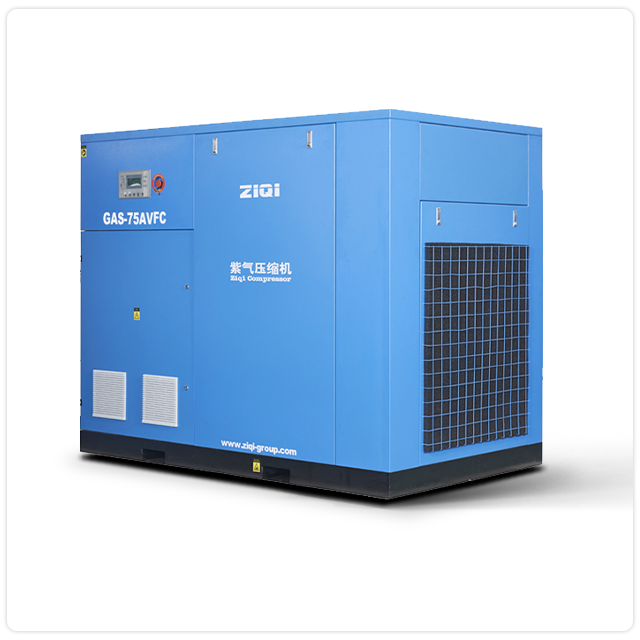
The GAT Series Two-Stage Compressor utilizes a WEG IE4 motor with IP55 protection for continuous heavy-duty operation.
If your facility operates with a fluctuating air demand, upgrading to an IE4 motor paired with VFD technology is highly recommended. You can calculate the exact electrical ROI by reviewing our VSD sizing and ROI guide.
Procurement teams often mistake the commercial warranty period (typically 1 to 2 years) for the actual mechanical durability of the machine. The true indicator of a compressor's longevity is the airend design life, which is an engineering calculation of how many hours the internal bearings and rotors can operate before requiring a major scheduled overhaul.
When reviewing a spec sheet, ask for the airend lifecycle data:
Single-Stage Compressors: Quality single-stage screw airends are engineered for a design life of 35,000 to 45,000 hours under standard industrial conditions.
Two-Stage Compressors: Heavy-duty machines that distribute the compression load across two stages experience far less bearing stress. For example, units equipped with genuine German GHH-RAND two-stage airends boast an extended design life of up to 100,000 hours.
If a supplier refuses to disclose the airend manufacturer or its calculated design life, the initial low purchase price will likely be overshadowed by premature bearing failure.
Send our engineering team your factory's air requirements or a competitor's quote. We will verify the true FAD, audit the motor efficiency, and provide an apples-to-apples technical comparison promptly.
QUICK LINKS
PRODUCTS
CONTACT US
 Email : inquiry@ziqi-group.com
 Tel: +86-15026767628
 Add:Building 2, No. 205, Jianding Road, Fengjing Town, Jinshan District, Shanghai City.China
PLEASE CONTACT US.

ZIQI Compressor (Shanghai) Co., Ltd
Copyright © 2026 ZIQI Compressor (Shanghai) Co., Ltd - All rights reserved.

