ZIQI Compressor For Global Energy Saving, Welcome To Contact Us.  008615026767628
Language
ZIQI Compressor For Global Energy Saving, Welcome To Contact Us. 008615026767628
Engineered for zero-tolerance contamination in pharmaceutical, food & beverage, and semiconductor cleanrooms. Certified ISO 8573-1 Class 0 by a leading oil-free air compressor manufacturer in China.
What is an oil-free air compressor? An oil-free air compressor is an industrial pneumatic machine engineered to compress ambient air without allowing any lubricating oil to enter the compression chamber. As a leading China-based manufacturer, ZIQI delivers Class 0 oil-free solutions using water lubrication, dry timing gears, or aerodynamic centrifugal impellers, guaranteeing that the discharged air stream is entirely devoid of hydrocarbon contamination.
Class 0 vs. Class 1 vs. Filtration: In the ISO 8573-1 air purity standards, "Class 1" permits a total oil concentration of 0.01 mg/m³, which is often achieved by forcing contaminated air from an oil-injected compressor through multi-stage filters. However, "Class 0" is the ultimate standard, demanding zero added oil during the compression process itself. While downstream filters can remove liquid oil aerosols, they cannot reliably stop oil vapor under high ambient temperatures.
Why Filters Cannot Replace True Oil-Free Machines: The integrity of a filtration system is volatile. If a coalescing element ruptures or an activated carbon tower becomes saturated due to a temperature spike, the entire downstream piping network and production batch will be contaminated. For critical sectors like pharmaceutical processing, semiconductor manufacturing, and automotive coating, true Class 0 oil-free compressors physically eliminate the risk by removing oil from the mechanical architecture entirely.
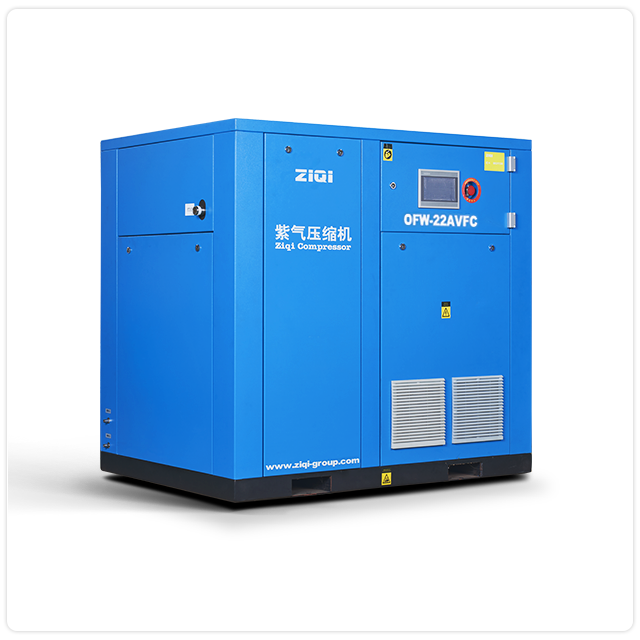
15–160 kW · ISO 8573-1 Class 0
Utilizes pure water as a hydrodynamic lubricant and coolant. No oil is present anywhere near the compression chamber. Low operating temperatures provide exceptional volumetric efficiency for food, pharmaceutical, and electronics facilities.
View OFW Series →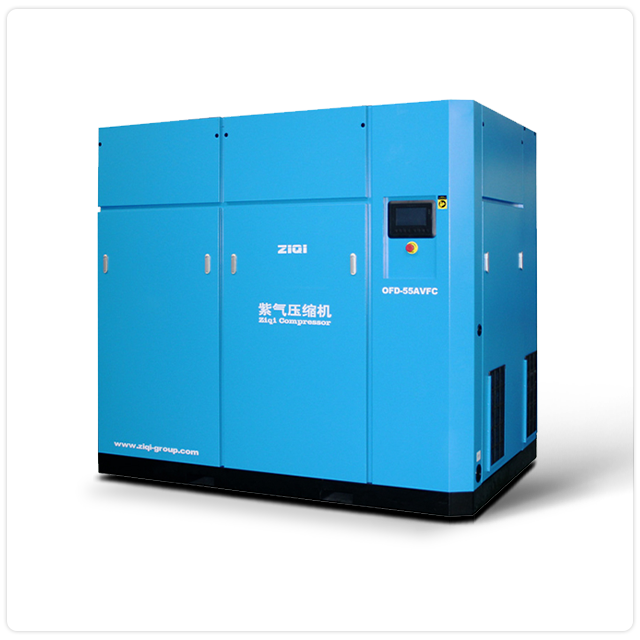
45–355 kW · No liquid in compression
Engineered with synchronized precision timing gears and advanced rotor coatings, ensuring the rotors never touch and require zero liquid sealing. Perfect for high-temperature chemical processing, glass manufacturing, and heavy semiconductor plants.
View OFD Series →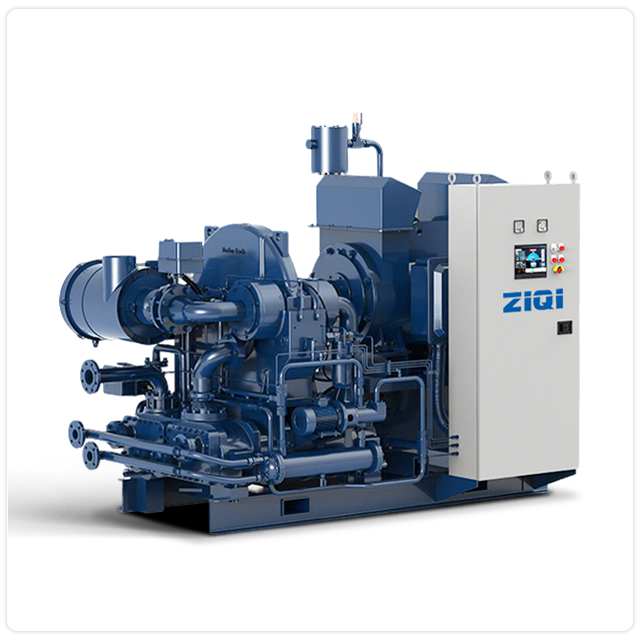
Large-Volume · Continuous-Duty · Naturally Oil-Free
Centrifugal compressors are inherently oil-free by mechanical design — the high-speed impeller compresses air through aerodynamic force, with no oil circuit inside the compression stage at all. Unlike OFW and OFD screw technology, which target small-to-medium precision applications, centrifugal compressors are engineered for massive continuous-duty volumes — steel mills, petrochemical plants, and large-scale manufacturing requiring 24/7 base-load air supply.
View GBTB Series →Technical Selection Guidance: Choosing between screw and centrifugal oil-free technology depends entirely on your required volume and duty cycle. OFW and OFD screw compressors excel at precision, moderate-flow applications (15–355 kW). GBTB centrifugal units are built for continuous, high-volume industrial base loads where oil-free air is inherent to the machine's aerodynamic design — not an added feature.
Attempting to achieve absolute air purity by filtering contaminated air from a standard oil-injected compressor introduces severe systemic risks and hidden lifecycle costs. Here is the engineering reality:
Catastrophic Separator Failure: Traditional machines rely on an internal air/oil separator element to retain lubricating fluid. If this element collapses or experiences a pressure surge, massive volumes of bulk oil mist will instantly flood the downstream piping network, completely destroying pneumatic valves and contaminating the final product.
Temperature-Dependent Adsorption Failure: Many facilities use activated carbon towers to capture oil vapors. However, carbon adsorption is ruled by thermodynamics. As the ambient temperature rises during summer months (above 25°C), the carbon's capacity to trap vapor drops logarithmically. The oil vapor penetrates the filter matrix and condenses back into liquid oil deep within your cleanroom equipment.
Class 0 is Source Elimination, Not Filtration: The ISO 8573-1 Class 0 standard was developed to enforce absolute safety. It dictates that total oil concentration must be strictly below detection limits under all operating conditions. Rather than attempting to trap oil after it has been atomized, true Class 0 oil-free architecture physically eliminates the pollutant from the generation process entirely.
Elimination of Condensate Disposal Costs: When compressing air, atmospheric moisture condenses. In an oil-injected system, this condensate is an aggressive, toxic oil-water emulsion that requires expensive, legally mandated hazardous waste treatment. Oil-free compressors generate pure water condensate that can typically be discharged safely into standard municipal drains.
Read the comprehensive engineering analysis: Oil-Free vs Oil-Flooded Screw Compressor Sizing
| Industry Sector | Why Oil-Free is Mandatory | Required Air Quality | Recommended Model |
|---|---|---|---|
| Food & Beverage | Direct contact with ingredients; FDA/HACCP compliance. Oil causes product spoilage and toxic contamination. | Class 0 (Oil), Class 2 (Water) | OFW Water-Lubricated |
| Pharmaceuticals | Aeration, tablet coating, and fermentation require strict cleanroom validation and zero biological/chemical contaminants. | Class 0 (Oil), Class 1 (Water) | OFW Water-Lubricated |
| Electronics & SMT | PCB cleaning and pneumatic pick-and-place tools. Microscopic oil droplets cause severe short circuits and soldering defects. | Class 0 (Oil), Class 2 (Dust) | OFW / OFD Series |
| Automotive Paint Shop | Robotic spray painting requires perfect surface tension. Oil aerosols cause "fish-eyes" and massive coating failures. | Class 0 (Oil), Class 2 (Water) | OFW Water-Lubricated |
| Semiconductor Wafer Fab | Wafer fabrication demands absolute purity. Any hydrocarbon trace ruins the nanometer-scale lithography process. | Class 0 (Oil), Class 1 (Dew Point) | OFD Dry Screw / GBTB |
| Chemical Instrument Air | Pneumatic control valves and sensitive instruments in refineries will clog or fail if exposed to oil vapor and sludge. | Class 0 (Oil), Class 2 (Water) | OFD Dry Screw / GBTB |
| Medical & Hospital | Breathing air for surgical theaters and patient ventilators strictly forbids any hydrocarbon vapor exposure. | Class 0 (Oil), Medical Grade | OFW Water-Lubricated |
| Textile Air-Jet Looms | High-speed air-jet weaving utilizes compressed air to propel the weft yarn. Oil mist permanently stains high-value fabrics. | Class 0 (Oil), Class 3 (Water) | OFD Dry Screw |
Evaluate your process sensitivities. If your application tolerates moisture in the raw compression phase (which is later removed by dryers), the OFW Water-Lubricated series is highly recommended due to its superior cooling and lower operating temperatures. If your chemical process demands an absolutely dry compression chamber with zero liquid presence, specify the OFD Dry Screw architecture.
Assess the maximum Free Air Delivery (FAD) required by your facility. For small to medium-scale operations demanding between 15 kW and 160 kW of power, the highly efficient OFW series provides the best return on investment. For massive industrial plants, glass manufacturing, or continuous chemical processes requiring 45 kW up to 355 kW, the robust heavy-duty OFD Dry Screw series is the mandatory choice. For plant-wide base load exceeding these ranges, consider the GBTB Centrifugal Series.
Class 0 certified air addresses oil, but you must also address moisture. If your facility (such as general electronics or automotive painting) only requires standard dry air, pair the compressor with a refrigerated air dryer (+3°C PDP). However, if you are operating a pharmaceutical cleanroom, EV battery assembly, or semiconductor fab, you must pair the oil-free compressor with a desiccant air dryer to achieve an ultra-low -40°C or -70°C PDP.
Review the physical footprint available in your utility room. If you are building a massive centralized compressor house, standalone base-load units with separate downstream purification equipment are standard. Ensure adequate ventilation and high-efficiency intake filtration for dusty environments.
Tell us your application, required flow (m³/min or CFM), pressure and dew point. Our engineers will specify the exact OFW, OFD, or GBTB configuration within 24 hours.
QUICK LINKS
PRODUCTS
CONTACT US
 Email : inquiry@ziqi-group.com
 Tel: +86-15026767628
 Add:Building 2, No. 205, Jianding Road, Fengjing Town, Jinshan District, Shanghai City.China
PLEASE CONTACT US.

ZIQI Compressor (Shanghai) Co., Ltd
Copyright © 2026 ZIQI Compressor (Shanghai) Co., Ltd - All rights reserved.

