ZIQI Compressor For Global Energy Saving, Welcome To Contact Us.  008615026767628
Language
ZIQI Compressor For Global Energy Saving, Welcome To Contact Us. 008615026767628

Compressed Air Systems Engineer
ZIQI Compressor Group · Updated July 2026
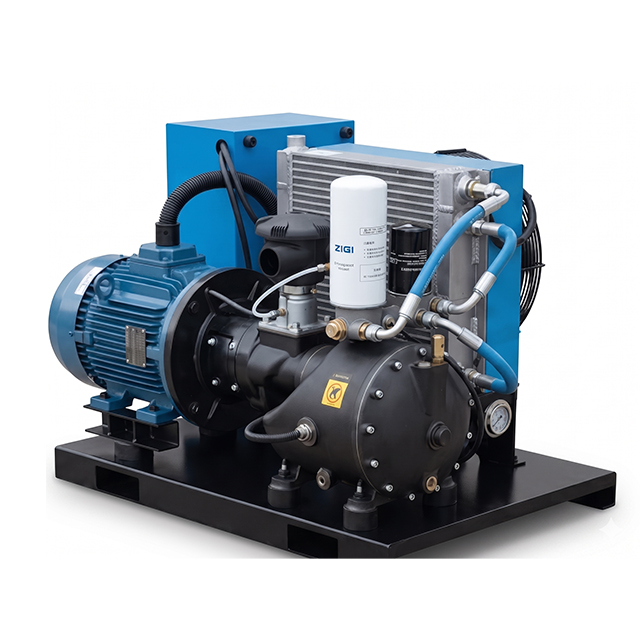
The global rail transit industry is fundamentally shifting away from legacy reciprocating (piston) air compressors toward oil-injected rotary screw architectures for auxiliary per-coach pneumatic supply. As a premier global air compressor manufacturer, ZIQI delivers screw compressors that provide a 100% continuous duty cycle, drastically lower mechanical vibration, and near-zero oil carryover — protecting critical downstream door mechanisms and suspension levelling valves. This 2026 technical guide outlines the exact engineering requirements for rail deployment, including native 72V DC controllers and IEC 61373 vibration compliance, highlighted by ZIQI's recent 30-unit modernization deployment at the Caracas Metro.
For decades, transit authorities relied on bulky, noisy reciprocating piston compressors to provide auxiliary air for metro coaches. Today, the demands of high-frequency dispatch schedules and stringent maintenance budgets have rendered piston technology obsolete in modern rolling stock.
Serving transit authorities in over 100 countries, ZIQI engineers have validated this transition across multiple international rail networks. The shift is driven by uncompromising physical limitations inherent to reciprocating designs.
📍 Project: Metro de Caracas, Venezuela
🚇 Network: 5 lines, 50+ stations, 1.7M+ daily passengers
📦 Quantity: 30 units
⚙️ Equipment: 7.5kW / 208V / 60Hz / 0.87 m³/min @ 9bar
🤝 Supply Mode: Direct supply to metro operator
In 2026, ZIQI delivered 30 units of customized 7.5kW auxiliary screw compressors to Metro de Caracas, supplied directly to the transit operator. This deployment continues the network's rolling stock modernization journey that began with earlier piston-to-screw migrations in 2012, marking ZIQI as a key participant in the long-term technical evolution of one of Latin America's highest-volume metro systems.
| Parameter | Rotary Screw (ZIQI Rail Series) | Legacy Reciprocating (Piston) |
|---|---|---|
| Duty Cycle | 100% Continuous | 50-70% Intermittent |
| Vibration Output | Extremely Low (Rotary motion) | High (Unbalanced reciprocating mass) |
| Oil Carryover | < 3 ppm | High (Increases as piston rings wear) |
| Major Overhaul Interval | 40,000+ Hours | 8,000 - 15,000 Hours (Valves/Rings) |
| Space Efficiency | High (Integrated block design) | Low (Requires oversized receiver tanks) |
Procuring an industrial air compressor and mounting it to a train is a recipe for failure. Transit authorities must evaluate rolling-stock specific engineering adaptations. Follow this 5-step buying guide to specify the correct auxiliary compressor.
Metro networks are upgrading to rotary screw compressors because they offer a 100% continuous duty cycle, generate significantly less vibration (which protects the coach chassis), and drastically reduce oil carryover into sensitive pneumatic door and braking systems compared to legacy reciprocating piston units.
The main drive motor typically requires 3-phase AC power matching the regional transit grid (e.g., 208V/60Hz or 380V/50Hz). However, the critical distinction is the control circuit: rolling stock universally uses 72V DC or 110V DC. A native DC controller is essential to interface directly with the train's battery management system without external inverters.
IEC 61373 is the international standard governing shock and vibration tests for railway rolling stock equipment. Air compressors mounted under the floor or inside a coach must be designed to withstand these specific resonant frequencies and physical shocks without structural or electrical failure.
A standard per-coach auxiliary pneumatic system (powering doors, brake supplements, air suspension levelling, and horns) typically requires between 0.5 to 1.0 m³/min (17 to 35 CFM) at 8 to 10 bar. A 7.5kW rotary screw compressor is the industry standard size for this demand.
Custom voltage / frequency / pressure / IEC compliance available. Direct factory supply with full project documentation from ZIQI.
QUICK LINKS
PRODUCTS
CONTACT US
 Email : inquiry@ziqi-group.com
 Tel: +86-15026767628
 Add:Building 2, No. 205, Jianding Road, Fengjing Town, Jinshan District, Shanghai City.China
PLEASE CONTACT US.

ZIQI Compressor (Shanghai) Co., Ltd
Copyright © 2026 ZIQI Compressor (Shanghai) Co., Ltd - All rights reserved.

