Rail-Grade Auxiliary Air PowerZIQI Rail Transit Auxiliary Air Compressor — 7.5kW / 208V / 60Hz
Per-coach screw compressor for metro doors, brake supplement, and suspension levelling. Designed for continuous under-floor deployment.
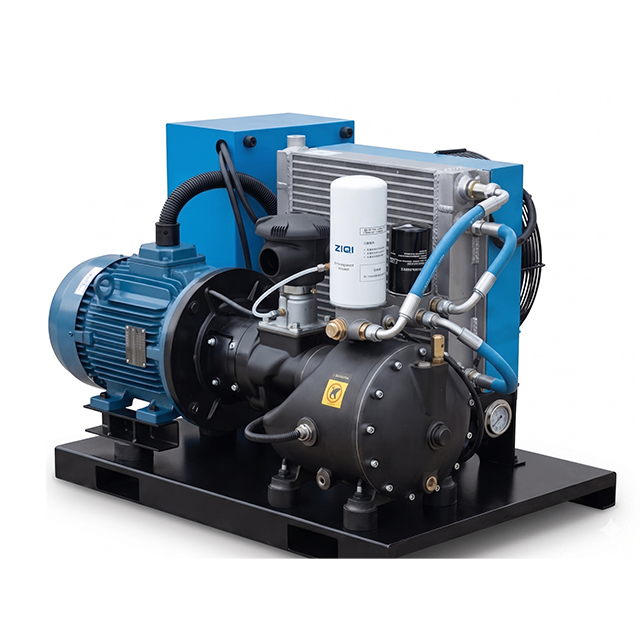
The ZIQI Rail Transit Air Compressor is a 7.5kW oil-injected rotary screw compressor purpose-engineered for per-coach auxiliary pneumatic systems on metro trains, light rail vehicles, and EMUs. With a WEG IE3 motor, 72V DC rail-grade controller, 208V/60Hz power configuration, and a compact 300×170×570 mm cabinet, it delivers 0.87 m³/min FAD at 9 bar to power pneumatic doors, brake supplement systems, and suspension levelling actuators. The unit features dual rail-grade safety connectors (220V 3-phase power + ≤3-pin signal) integrated into a single combined cabinet connector to reduce coach wiring complexity. Designed to comply with IEC 61373 (rolling stock vibration) and EN 50155 (electronic equipment for railways).
As a leading railway air compressor manufacturer in China serving 100+ countries, ZIQI engineers have validated this piston-to-screw transition firsthand across multiple transit networks. Legacy piston compressors struggle with the continuous demands of high-frequency dispatch schedules, making the structural upgrade to rotary screw technology essential.
🔄
Continuous Duty Cycle
Piston compressors are mechanically restricted to a 60% to 70% intermittent duty cycle to prevent thermal valve failure. Screw compressors utilize oil-injected rotary mechanics allowing for a 100% continuous duty cycle, delivering unwavering baseload air pressure.
🚄
Vibration Tolerance
The reciprocating motion of a piston compressor generates severe unbalanced vibration. Rotary screw architecture features smooth, continuous rotation (no reciprocating mass), dramatically lowering the mechanical vibration transmitted to the rolling stock bogie.
💰
Lifecycle Cost
Piston rings and valves wear out rapidly under heavy transit loads, requiring overhauls every 50,000 kilometers. The non-contact interlocking rotors of a screw airend dramatically reduce mechanical friction, extending the major overhaul interval to over 200,000 kilometers.
| Free Air Delivery | 0.87 m³/min (30.7 CFM) |
| Working Pressure | 9 bar (130 PSI) |
| Motor Power | 7.5 kW / 10 HP |
| Motor Brand | WEG (Brazil) — IE3/IE4 class |
| Compression Stage | Single-stage rotary screw (oil-injected) |
| Cooling | Air-cooled (axial fan + finned cooler) |
| Main Voltage | 208V / 3-phase |
| Frequency | 60 Hz (Americas standard) |
| Power Connector | 220V 3-phase rail-grade safety connector |
| Controller Voltage | 72V DC (rolling stock standard) |
| Signal Connector | Up to 3-pin |
| Integrated Connector | Single combined power + signal on cabinet |
| Cabinet Dimensions | 300 × 170 × 570 mm (W × D × H) |
| Front Cover | 4-screw fixed (service-only access) |
| Cable Gland | IP-rated waterproof |
| HMI Display Protection | Waterproof / dustproof / oilproof / impact-resistant |
| HMI Front Shield | Acrylic glass guard |
| Application | Metro / Light Rail / EMU (Per-coach mounting) |
🛏️
Suspension Air
Levelling
IEC 61373 — Railway applications — Rolling stock equipment — Shock and vibration tests
EN 50155 — Railway applications — Electronic equipment used on rolling stock
ISO 1217 Annex C — Displacement compressors — Acceptance tests
ISO 8573-1 — Compressed air — Contaminants and purity classes
UIC 542 — Brake parts standardization (referenced baseline)
What CFM and pressure does a metro train auxiliary compressor need?
A typical per-coach auxiliary compressor for metro trains requires between 0.5 to 1.0 m³/min (17 to 35 CFM) at a discharge pressure of 8 to 10 bar. The ZIQI 7.5kW unit provides 0.87 m³/min at 9 bar, perfectly sized for modern railcar pneumatic demands.
Why is 208V/60Hz used in Americas-region rail systems?
208V 3-phase at 60Hz is a standard industrial voltage in many parts of the Americas, including Venezuela and parts of North America. Matching the compressor's primary drive motor to the local transit authority's grid infrastructure eliminates the need for heavy onboard transformers.
Can this compressor be used as a brake system primary?
No. This 7.5kW unit is engineered as an auxiliary per-coach compressor designed for brake supplement, pneumatic doors, and suspension levelling. It operates alongside, rather than replacing, the main heavy-duty brake compressors.
What is the difference between IEC 61373 Category 1 Class A and Class B?
IEC 61373 standardizes shock and vibration tests for railway rolling stock. Category 1 covers body-mounted equipment. Class A refers to items mounted directly to the car body, while Class B refers to items mounted inside equipment cases under or inside the vehicle. The ZIQI compressor chassis is designed to withstand these specific resonant frequencies.
How does a screw compressor outperform piston on metro applications?
Screw compressors operate with a 100% continuous duty cycle, generate significantly less vibration (crucial for under-floor train mounting), and drastically reduce oil carryover into the pneumatic braking and door valve systems compared to reciprocating piston units.
Is this compressor suitable for high-altitude operation?
Yes, rotary screw compressors perform reliably at altitude. However, the exact FAD (Free Air Delivery) and cooling efficiency will derate based on the specific atmospheric density. Consult ZIQI engineers with your transit network's maximum elevation for precise output calculations.
What maintenance interval applies to rail transit screw compressors?
Standard consumable maintenance (oil, air filter, oil filter, separator) typically follows a 2,000 to 4,000-hour operational cycle. The core rotary screw airend is designed to exceed 40,000 hours before a major mechanical overhaul is required.
Can ZIQI provide a bare airend assembly without enclosure?
Yes. We offer an 'Option B' bare unit assembly for Tier 1 OEMs, coach builders, and train manufacturers who prefer to integrate the compressor block directly into their own custom under-carriage enclosures.
Does this product support EN 50155 cold start at -25°C?
Our standard units are rated for typical transit environments. For extreme cold-climate deployments compliant with EN 50155 Class TX (-40°C), specialized synthetic lubricants, automated block heaters, and cold-rated seals must be factory-specified.
How do I request technical drawings and deployment specifications?
Detailed project documentation, compliance test reports, and technical drawings can be requested directly through our engineering sales team via the contact form or WhatsApp.
Why does ZIQI use a 72V DC controller instead of 220V AC?
Rail rolling stock auxiliary power is standardized at 72V/110V DC. A native 72V DC controller eliminates the need for additional voltage conversion equipment, reducing coach electrical complexity and improving reliability under vibration.
What is the advantage of dual rail-grade connectors?
Separating the 220V 3-phase power circuit from the ≤3-pin signal circuit, while integrating both into a single combined cabinet connector, reduces in-coach wiring labor and minimizes connection failure points under continuous rail vibration.
Need a Rail-Spec Compressor for Your Project?
Custom voltage / frequency / pressure / IEC compliance available. Direct factory supply with full project documentation from ZIQI.
 008615026767628

 Email :
 Tel: +86-15026767628
 Add:

