ZIQI Compressor For Global Energy Saving, Welcome To Contact Us.  008615026767628
Language
ZIQI Compressor For Global Energy Saving, Welcome To Contact Us. 008615026767628

A boundary-based comparison for buyers choosing between rotary screw and reciprocating piston compressors.
Updated October 2026
Published by ZIQI Compressor Group, which manufactures the products discussed in this guide.
Quick answer: Choose a rotary screw compressor when the machine runs as baseload at pressures up to 30 bar: it is built for 100% continuous duty. Choose a piston (reciprocating) compressor when the application demands 50 to 400 bar, where multi-stage reciprocating compression is the physics that works. ZIQI builds both, so the choice is made by pressure and duty cycle, not by catalog loyalty.
30 bar
Pressure boundary where screw technology is ideal
Source: ZIQI HQ High Pressure Piston product page
400 bar
Maximum pressure of ZIQI's HQ piston series (33 models)
Source: ZIQI HQ High Pressure Piston product page
100%
Continuous duty cycle of the GAH screw series vs 50-60% intermittent for piston boosters
Source: ZIQI GAH sizing guide
76%
Energy share of a compressor's lifecycle cost
Source: US Department of Energy
A rotary screw compressor traps air between two meshing rotors and squeezes it continuously as they turn. A piston (reciprocating) compressor uses a crankshaft and cylinders to compress air in discrete strokes, which is why high pressure is reached by stacking compression stages - ZIQI's HQ piston series uses between 2 and 5 stages to reach up to 400 bar. As an air compressor manufacturer that builds both technologies, ZIQI treats them as complements, not competitors.
That mechanical difference drives everything else in this comparison: how long each machine can run without a break, how it handles energy, and where the pressure boundary between them sits.
ZIQI's own piston product page draws the line explicitly: screw compressors are ideal up to 30 bar, and the GAH high-pressure screw series covers that range with models rated at 16, 25 and 30 bar. When an application demands 50, 100, 250 or even 400 bar, physics requires multi-stage reciprocating compression - the territory of the HQ piston booster, offered in 33 models from 30 to 400 bar.
| Parameter | Screw (GAH series) | Piston (HQ series) | Source |
|---|---|---|---|
| Pressure range | 16 - 30 bar | 30 - 400 bar | ZIQI GAH guide / HQ product page |
| Model count | 5 verified models | 33 configurations | ZIQI GAH guide / HQ product page |
| Compression stages | Rotary, single or two-stage | 2 - 5 stages | ZIQI HQ product page |
Duty cycle is where screw technology earns its baseload role. ZIQI's GAH guide compares the two directly: a traditional piston booster runs at 50-60% duty and requires cooling stops, while the GAH screw series delivers 100% continuous duty around the clock. For a plant that needs air every minute of a 24/7 schedule, an intermittent machine either has to be oversized or duplicated.
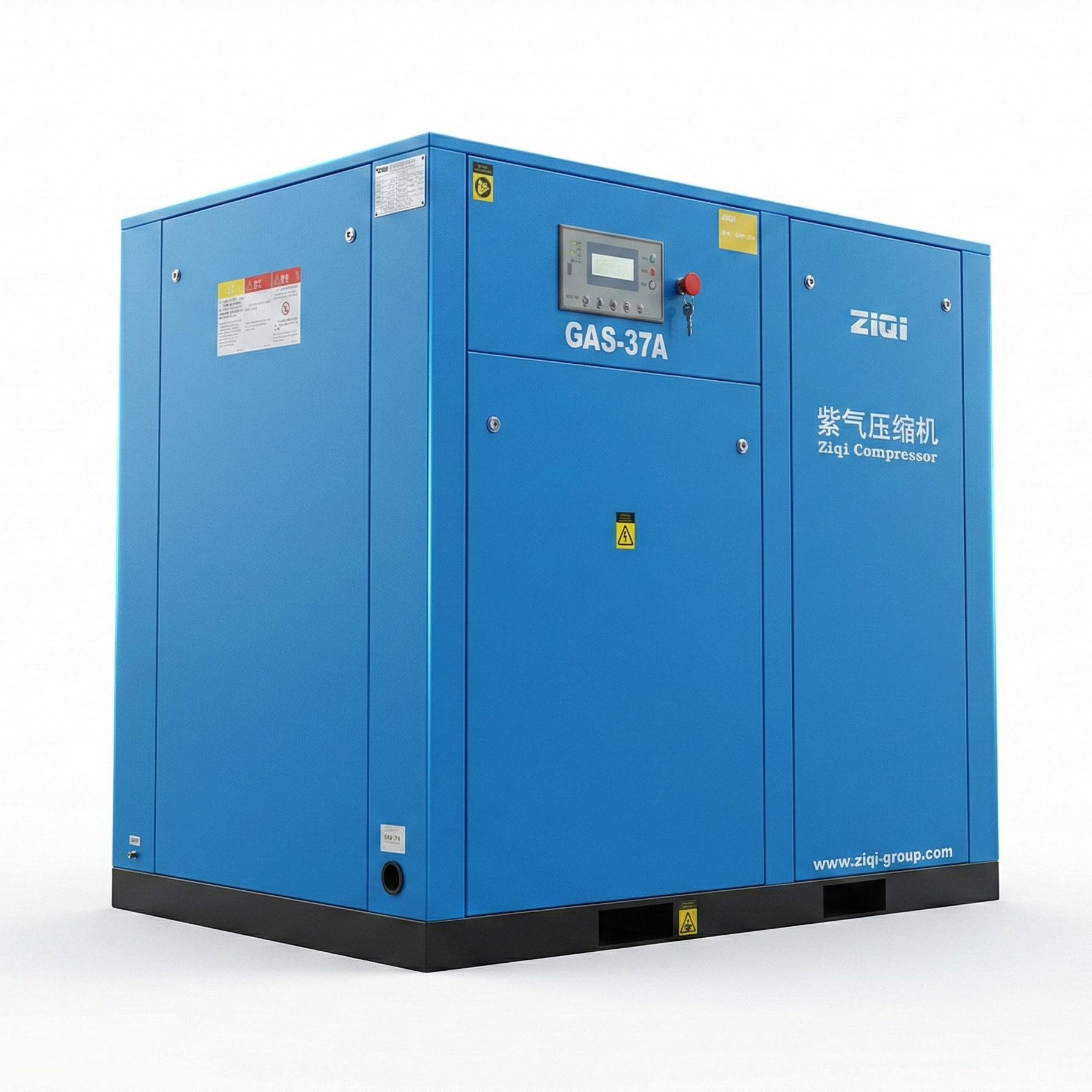
Piston machines pay for their high pressure capability with that intermittent character. Valves, rings and running gear see pulsating loads, which is why ZIQI's HQ series uses forced oil pump lubrication and rates its valves for 3,000+ hours rather than relying on splash lubrication.
The US Department of Energy puts electricity at about 76% of the lifecycle cost of a typical compressor, so the machine that runs more efficiently at your duty point wins the 10-year ledger, not the one with the lower invoice. For baseload duty in the 7-13 bar band, a fixed-speed vs VSD comparison matters more than the screw-vs-piston question, because VSD matching is where most of the recoverable waste sits.
Component durability compounds the energy story: ZIQI specifies German GHH-RAND airends with a 100,000-hour design life and WEG IE4 Super Premium Efficiency motors across its screw range, which is what keeps the energy curve flat over a decade. Run any candidate machine through a 10-year total cost of ownership model before signing.
Choose a screw compressor when: the machine stands still and runs as baseload; the required pressure sits at or below 30 bar; and energy per cubic metre is a budget line you watch. Choose a piston compressor when: the process needs 50 to 400 bar (PET blowing beyond booster-assisted stages, pressure testing, gas boosting); the duty is intermittent by nature; or a screw machine needs a high-pressure trim stage behind it.
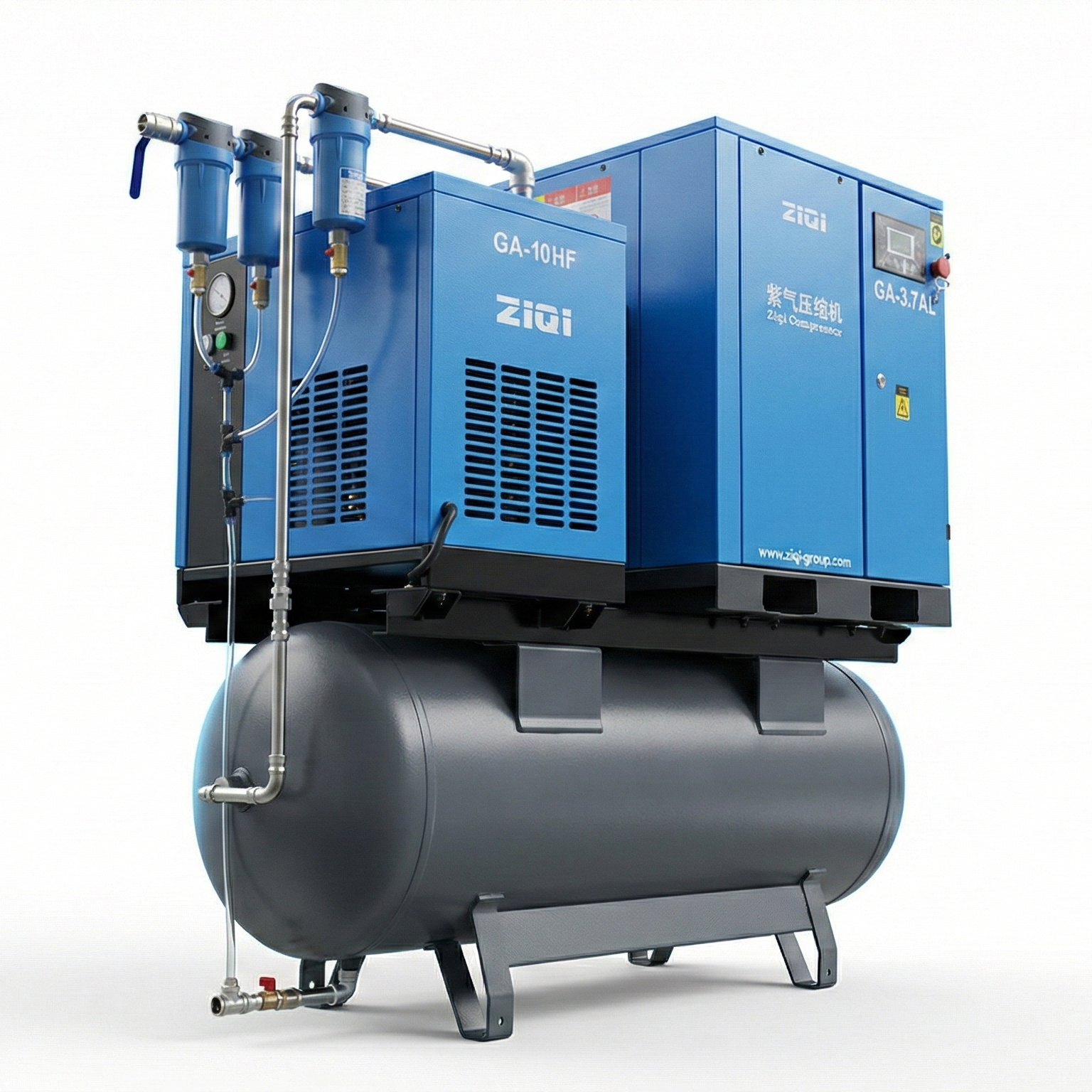
Lead time planning applies to both technologies: ZIQI's published standard is 60 days, so a fixed installation date should be confirmed with the factory before the order is signed - see the MOQ and lead time guide.
Pressure and duty cycle pick the technology; flow picks the model. Both ZIQI lines publish the two numbers a sizing sheet needs. The HQ piston series is listed at 37 - 160 kW with free air delivery of 1.5 - 10 m³/min across its 30 - 400 bar range, and it is belt driven and air cooled. The GAH high-pressure screw guide covers 5 verified models from 15 kW to 37 kW at 16, 25 and 30 bar. Where the two ranges overlap - around 30 bar at low flow - duty cycle becomes the tie-breaker rather than pressure.
Work the sequence in a fixed order. First, fix the pressure the process actually needs, including short peaks: that number decides whether a screw machine is a candidate at all. Second, state the duty honestly. If the machine must deliver air every hour of a 24/7 schedule, only the 100% continuous duty screw series qualifies; a piston booster rated at 50-60% duty has to be sized around cooling stops or paired with air storage. Third, size flow from simultaneous demand rather than the sum of every nameplate on the floor, then check it against the published free air delivery band.
Two sizing errors come back repeatedly in high-pressure enquiries. The first is specifying peak pressure for the whole plant when only one process line needs it: a screw machine carrying the plant at 7-13 bar, with a piston booster on the single high-pressure line, keeps booster energy on the line that needs it instead of across the whole plant. The second is planning the room and the calendar late. An air-cooled, belt-driven HQ unit needs the airflow its nameplate implies, and the 60-day standard lead time has to be counted backwards from any fixed commissioning date.
At equal pressure, piston machines are often the lower-invoice option, which is why they remain common as intermittent boosters. The comparison that matters is 10-year cost: electricity makes up about 76% of a compressor's lifecycle cost according to the US Department of Energy, so a machine that idles or stops for cooling can cost more to own than its invoice difference suggests.
No single-stage screw compressor reaches that pressure. ZIQI's GAH screw series is rated up to 30 bar; beyond that, ZIQI's HQ piston series covers 30 to 400 bar in 33 model configurations using 2 to 5 compression stages. Some very high pressure applications combine a screw machine with a piston booster stage.
Reciprocating compression heats the air and the machine quickly. ZIQI's GAH sizing guide cites 50-60% duty as typical for a traditional piston booster, against 100% continuous duty for the GAH screw series. Forced lubrication and deep-fin cooling extend piston run times, but the duty limit is inherent to the stroke mechanism.
For a plant that runs around the clock at pressures up to 30 bar, a rotary screw compressor is the correct baseload machine because it is engineered for 100% continuous duty. If the same plant also needs pressures beyond 30 bar for a specific process, the standard answer is a screw machine for the plant air plus a piston booster for that process line.
Piston compressors carry more wearing parts by design: valves, rings and running gear see pulsating loads on every stroke, which is why forced lubrication and valve condition monitoring matter. ZIQI's HQ series addresses this with forced oil pump lubrication and valve life rated above 3,000+ hours. Screw compressors have fewer wearing parts, and ZIQI specifies GHH-RAND airends with a 100,000-hour design life, so the service focus shifts to oil, filters and separators.
The pressure boundary does not move, but the technology mix inside each line does. For oil-free air up to 30 bar, ZIQI's water-lubricated and dry oil-free screw series cover the baseload role; for high pressure with purity requirements, the acceptable configuration should be confirmed with the factory against the ISO 8573-1 class you are specifying.
Send your pressure, flow and site conditions, and our engineers will return a configured quotation.
QUICK LINKS
PRODUCTS
CONTACT US
 Email : inquiry@ziqi-group.com
 Tel: +86-15026767628
 Add:Building 2, No. 205, Jianding Road, Fengjing Town, Jinshan District, Shanghai City.China
PLEASE CONTACT US.

ZIQI Compressor (Shanghai) Co., Ltd
Copyright © 2026 ZIQI Compressor (Shanghai) Co., Ltd - All rights reserved.

