ZIQI Compressor For Global Energy Saving, Welcome To Contact Us.  008615026767628
Language
ZIQI Compressor For Global Energy Saving, Welcome To Contact Us. 008615026767628

ZIQI vs Kaeser BSD 75: A 37 kW Specification Comparison
Two 37 kW fixed-speed screw compressors, compared on the two pressure bands where both manufacturers publish data.
Updated November 2026
Published by ZIQI Compressor Group, which manufactures the products discussed in this guide.
Quick answer: Both are 37 kW fixed-speed oil-injected screw compressors, but they do not publish data on the same pressure bands. Both manufacturers publish a figure at 10 bar and at 13 bar. At 10 bar ZIQI publishes 5.7 m3/min and Kaeser publishes 5.6 m3/min, but ZIQI's figure is air displacement while Kaeser's is complete-system flow rate at working pressure, so the two numbers are not equivalent and should not be ranked against each other.
37 kW
Motor rating of both models
Source: ZIQI GAS brochure; Kaeser BSD specification page
10 bar
Lowest pressure band both publish
Source: ZIQI GAS brochure; Kaeser BSD specification page
5.7 / 5.6
m3/min at 10 bar, different definitions
Source: ZIQI air displacement; Kaeser system flow rate
60 days
ZIQI standard lead time
Source: ZIQI lead time page
Buyers searching for a Chinese alternative to a European screw compressor usually start by putting two datasheets side by side. As an air compressor manufacturer that quotes against European models every week, ZIQI sees this comparison go wrong in the same way almost every time: the two sheets do not describe the same pressure bands, and they do not describe the same quantity.
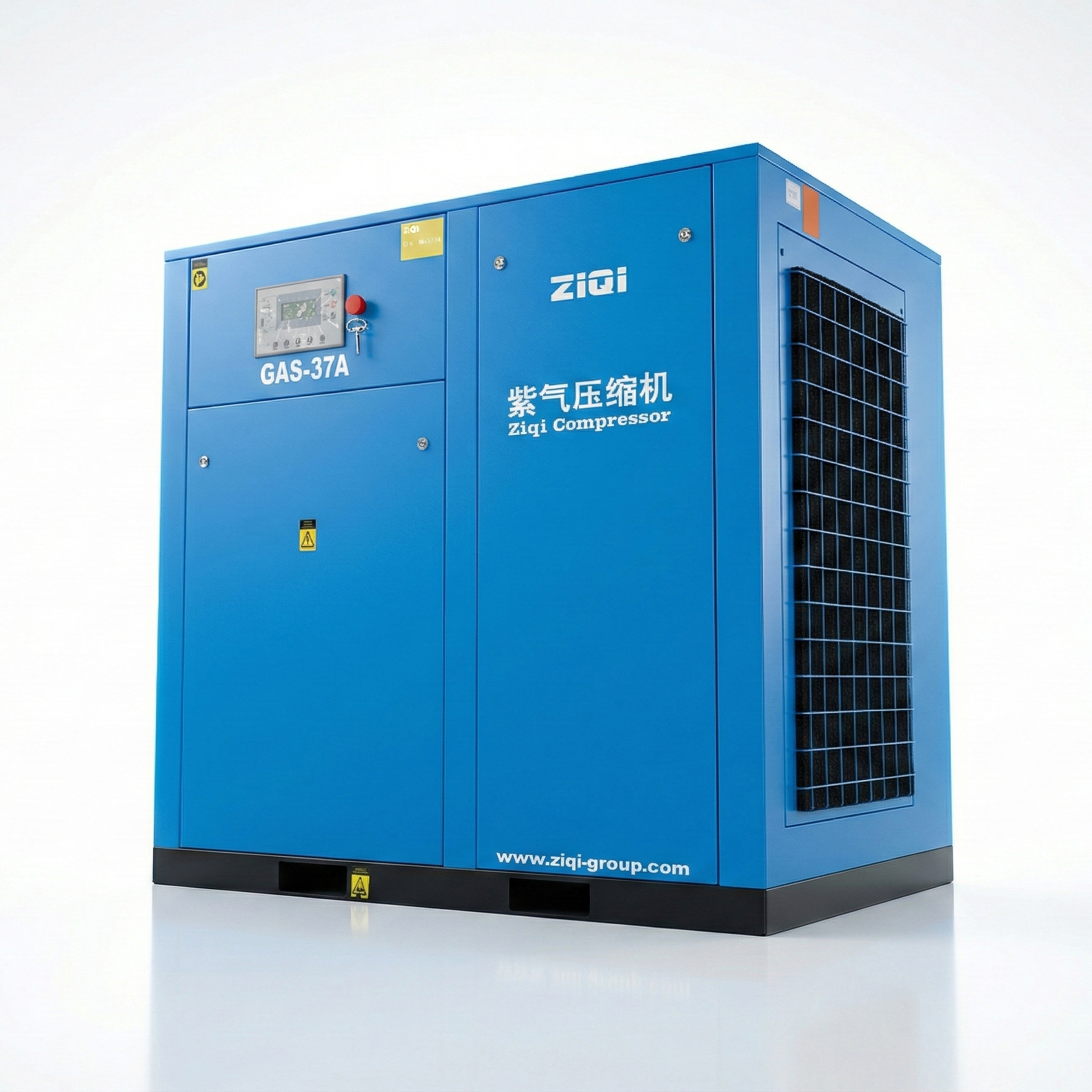
The ZIQI GA-37A and the Kaeser BSD 75 are both 37 kW fixed-speed oil-injected single-stage screw compressors. On paper that makes them competitors. In practice they publish at 0.7, 0.8, 1.0 and 1.3 MPa on one side and at 7.5, 10 and 13 bar on the other, so only two pressure bands overlap.
This comparison therefore does three things: it shows the figures that exist, it marks clearly where the two manufacturers measure different things, and it lists where each machine has a genuine advantage. It does not declare a winner, because the published data does not support one.
The table below lists only figures each manufacturer publishes. Where a manufacturer does not publish a band, the cell says so rather than being filled by interpolation.
| Working pressure | ZIQI GA-37A (m3/min) | Kaeser BSD 75 (m3/min) | Same band published by both | Source |
|---|---|---|---|---|
| 7 bar (0.7 MPa) | 6.8 | not published | No | ZIQI GAS brochure; Kaeser BSD specification page |
| 7.5 bar | not published | 7.0 | No | ZIQI GAS brochure; Kaeser BSD specification page |
| 8 bar (0.8 MPa) | 6.2 | not published | No | ZIQI GAS brochure; Kaeser BSD specification page |
| 10 bar (1.0 MPa) | 5.7 | 5.6 | Yes | ZIQI GAS brochure; Kaeser BSD specification page |
| 13 bar (1.3 MPa) | 4.8 | 4.43 | Yes | ZIQI GAS brochure; Kaeser BSD specification page |
Both figures in the 10 bar and 13 bar rows come from the manufacturers' own brochures. They are not, however, the same measurement. ZIQI publishes air displacement, which is the volume the compressor displaces per unit time. Kaeser publishes the flow rate of the complete system at working pressure, which is a delivered-flow figure. Delivered flow after losses is normally lower than displacement for the same machine, so a direct ranking of these two columns would be misleading in ZIQI's favour.
ZIQI does not currently publish free air delivery figures or a specific power value for the single-stage range. Until it does, this table shows that both machines sit in a similar size class at 10 bar and 13 bar, not that one delivers more air than the other.
A screw compressor delivers less air as the working pressure rises. The 6.8 m3/min that ZIQI publishes at 7 bar and the 7.0 m3/min that Kaeser publishes at 7.5 bar look close, but they are taken at different pressures and therefore describe different operating points.
Putting the 7 bar figure next to the 7.5 bar figure would make the lower-pressure machine look better for reasons that have nothing to do with engineering quality. The pressure bands are simply different. This is why the comparison table above marks those rows as not comparable, and why the screw air compressor buyers guide recommends fixing the pressure band before reading any delivery number.
If your plant runs at 7 bar, the Kaeser BSD 75 has no published figure at that band and you would need to ask Kaeser for it. If your plant runs at 7.5 bar, the ZIQI figure at 7 bar is not applicable and you would need a ZIQI quote for that band.
The two fixed-speed models are both specified with IE4 motors. The Kaeser variable-speed version, the BSD 75 SFC, is specified with an IE5 motor and an IES2 drive system.
| Model | Speed control | Motor efficiency class | Source |
|---|---|---|---|
| ZIQI GA-37A | Fixed speed | IE4 | ZIQI GAS brochure |
| Kaeser BSD 75 | Fixed speed | IE4 | Kaeser BSD specification page |
| Kaeser BSD 75 SFC | Variable speed | IE5 motor, IES2 drive system | Kaeser BSD specification page |
Efficiency classes are defined by IEC 60034-30-1 and describe the motor, not the compressor package. A higher class is not by itself evidence of lower package energy consumption, because the package also includes the airend, the cooling system and the control strategy. For the relationship between speed control and energy use, see the fixed speed vs VSD comparison.
| Model | Published sound level | Test conditions stated | Source |
|---|---|---|---|
| ZIQI GA-37A | 68 plus or minus 2 dB(A) | Pressure band, distance and test standard not stated in the brochure | ZIQI GAS brochure; Kaeser BSD specification page |
| Kaeser BSD 75 | 70 dB(A) at 7.5 bar | Stated as sound pressure level; measurement distance and standard not stated on the page | ZIQI GAS brochure; Kaeser BSD specification page |
Neither datasheet states a measurement distance or a test standard that would allow the two figures to be placed on the same scale. A 2 dB difference is also within the tolerance band published for the ZIQI figure. The two numbers are therefore listed for reference only, and this page does not describe either machine as quieter.
A useful comparison also records where the European machine is ahead. Three differences are visible directly in the published data.
Variable speed with a wide turndown. The BSD 75 SFC covers 1.54 to 7.44 m3/min at 7.5 bar, a range of roughly 4.8 to 1, and combines an IE5 motor with an IES2 drive system. ZIQI does not publish an equivalent variable-speed data set for this comparison, so on this point the published record favours Kaeser.
A dedicated controller platform. The BSD range is specified with SIGMA CONTROL 2, a controller family that Kaeser documents separately with its own monitoring and network features. Buyers who need a specific plant-level integration should compare that documentation against what ZIQI offers on the GA-37A.
A larger, heavier package. The BSD 75 measures 1,590 by 1,030 by 1,700 mm and weighs 985 kg at 7.5 bar, against 1,500 by 970 by 1,375 mm and 800 kg for the GA-37A. Greater mass is not automatically better, but in a fixed installation it often reflects more acoustic and structural material.
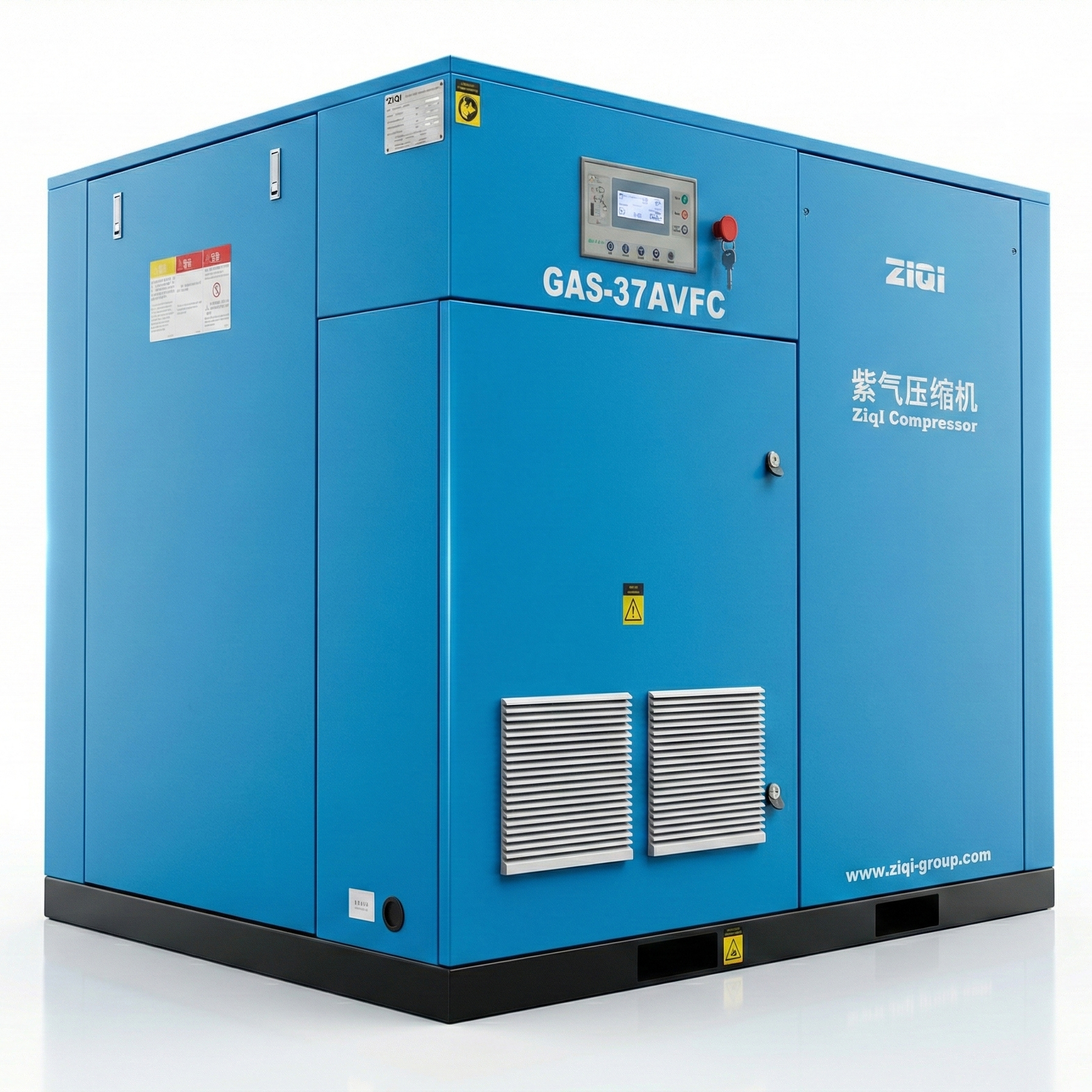
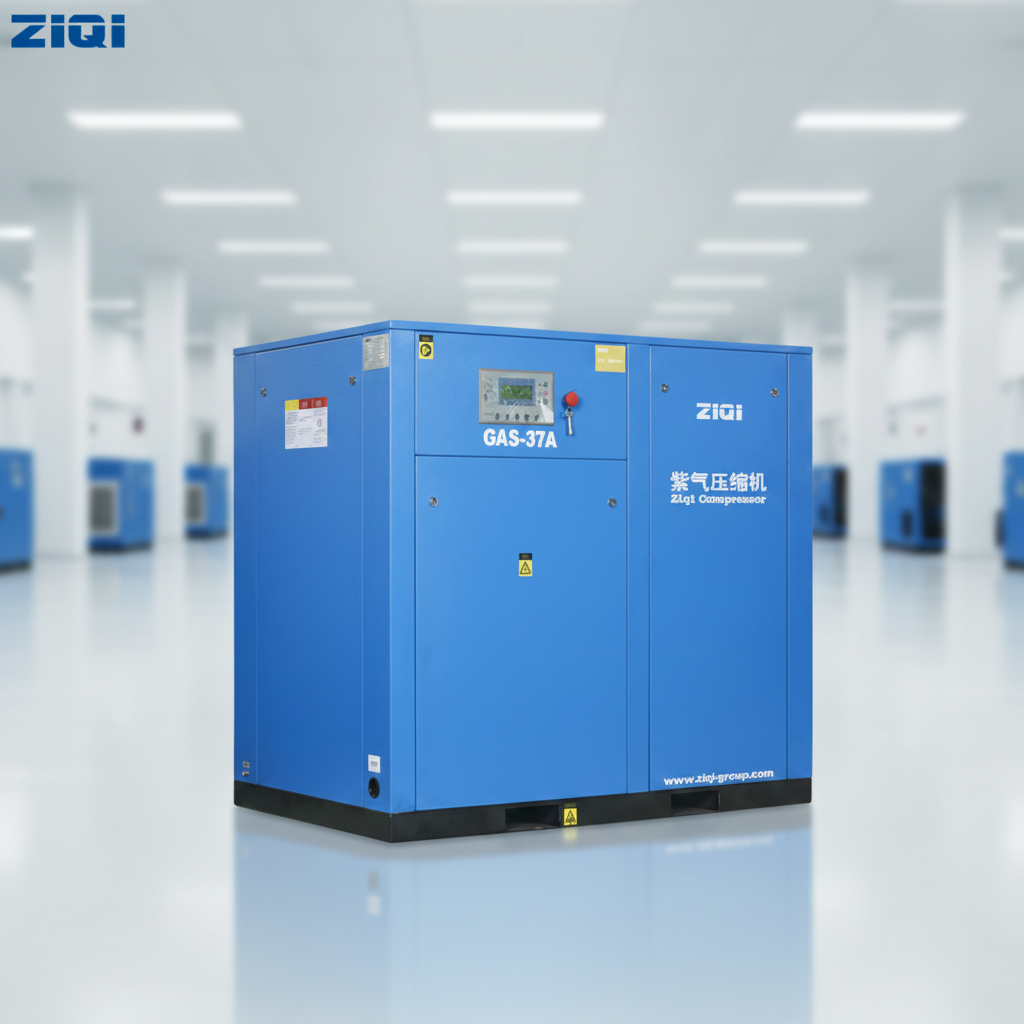
The GA-37A is the 37 kW model in the ZIQI GAS single-stage range. Its published specification lists a GHH-RAND airend, an IE4 motor, 304 stainless steel internal piping, and Siemens or Schneider controllers with an open architecture. The full range is described on the GAS series page.
Belt drive. The GAS series uses belt drive from 3.7 to 45 kW, and elastic direct coupling from 55 to 185 kW. The GA-37A is therefore a belt-driven machine. Belts are a wear item and need periodic replacement, which is a maintenance consideration rather than a performance one.
Smaller footprint. At 1,500 by 970 by 1,375 mm and 800 kg, the GA-37A is around 19 percent lighter than the BSD 75. For containerised plants, rooftop installations or retrofit projects where floor loading is constrained, that difference matters more than a fraction of a decibel.
Open controllers. Siemens or Schneider controllers with an open architecture let a local service team read and adjust the machine without returning to the original supplier. For buyers in markets where the European brand's service network is thin, that is often the deciding factor.
Standard lead time. ZIQI quotes 60 days as its standard lead time. Buyers planning around a fixed installation date should read the MOQ and lead time guide before comparing prices, because schedule risk is part of the total cost.
Four checks remove most of the ambiguity from any compressor comparison.
Fix the pressure band first. Read delivery only at the pressure your plant actually runs. A figure taken one bar lower will always look better.
Confirm the definition. Air displacement, delivered flow and free air delivery are three different quantities. Ask which one the datasheet uses before subtracting one number from another.
Ask for specific power. Package input power per unit of delivered air combines motor and airend efficiency into a single number. If a supplier cannot provide it, that absence is itself information. The total cost of ownership guide shows how specific power feeds into a lifecycle calculation.
Check the test standard. ISO 1217 is the reference method for displacement and energy measurement. A datasheet that does not name a standard cannot be checked against one that does.
They are both 37 kW fixed-speed oil-injected single-stage screw compressors and occupy a similar size class, but they are not drop-in equivalents. Their published pressure bands differ, their delivery figures use different definitions, and their package dimensions and weights differ. Any replacement should be checked against your actual pressure band, flow demand and pipe connection before ordering.
Air displacement is the volume the compressor displaces per unit time at a stated pressure. Free air delivery, often written FAD, is the volume of air actually delivered to the system after internal losses. Delivered flow is normally lower than displacement for the same machine, so the two figures cannot be subtracted from one another.
At 10 bar ZIQI publishes 5.7 m3/min and Kaeser publishes 5.6 m3/min, but the two figures are not the same quantity. ZIQI's number is air displacement from the GAS brochure, while Kaeser's is complete-system flow rate at working pressure. Because the definitions differ, this page lists them without ranking.
Yes. The ZIQI GA-37A is specified with an IE4 motor and the fixed-speed Kaeser BSD 75 is specified with an IE4 motor. The variable-speed Kaeser BSD 75 SFC is specified with an IE5 motor and an IES2 drive system. Efficiency classes describe the motor, not the whole compressor package.
The published figures are 68 plus or minus 2 dB(A) for the GA-37A and 70 dB(A) for the BSD 75 at 7.5 bar, but neither datasheet states a measurement distance or test standard, and the tolerance on the ZIQI figure is 2 dB. The two numbers are listed for reference and are not ranked here.
ZIQI quotes 60 days as its standard lead time. If your project has a fixed installation date, send it with your enquiry so the schedule can be confirmed against your configuration before you order.
Send your pressure, flow and site conditions, and our engineers will return a configured quotation.
QUICK LINKS
PRODUCTS
CONTACT US
 Email : inquiry@ziqi-group.com
 Tel: +86-15026767628
 Add:Building 2, No. 205, Jianding Road, Fengjing Town, Jinshan District, Shanghai City.China
PLEASE CONTACT US.

ZIQI Compressor (Shanghai) Co., Ltd
Copyright © 2026 ZIQI Compressor (Shanghai) Co., Ltd - All rights reserved.

