ZIQI Compressor For Global Energy Saving, Welcome To Contact Us.  008615026767628
Language
ZIQI Compressor For Global Energy Saving, Welcome To Contact Us. 008615026767628
ZIQI vs Kaishan is fundamentally a comparison between an export-grade specialist and a domestic-market giant. Kaishan is China's largest compressor manufacturer by domestic sales volume — reliable for general factory air supply within China. ZIQI uses German GHH-RAND airends, WEG IE4 pure copper motors, 304 stainless steel piping, and open Siemens/Schneider controllers — all documented by third-party certificates. On a 75kW unit running 6,000 hours/year, ZIQI saves $20,520/year in electricity over Kaishan's standard IE3 configuration and eliminates the proprietary controller service dependency that makes Kaishan expensive to maintain outside China.
Both ZIQI and Kaishan are genuine Chinese manufacturers — not trading companies. The difference is not about who is "real" or who has been operating longer. It is about what is inside the machine, whether those components can be independently verified, and what they cost you over the next decade of operation.
🇩🇪 German GHH-RAND airend — serial number verifiable
⚡ WEG IE4 PM VSD — 100% pure copper winding certified
🔩 304 Stainless Steel internal piping standard
🔓 Siemens / Schneider open-architecture controller
📄 4 third-party certificates shipped with every unit
🌍 Exports to 130+ countries, founded 2007 Shanghai
🏭 In-house domestic airend — no traceable serial number
⚠️ IE3 induction motor standard — winding material undisclosed
🔩 Carbon steel internal piping standard
🔒 Proprietary Kaishan controller — OEM service required
📄 No third-party component certificates available
🇨🇳 Largest by domestic volume, limited export infrastructure
The airend — the screw compression element — is the single most important component in any compressor. It determines volumetric efficiency, long-term output stability, and overhaul cost. This is where the ZIQI vs Kaishan gap is most significant.
| Airend Specification | ZIQI (GHH-RAND) | Kaishan (In-house) |
|---|---|---|
| Manufacturer | GHH-RAND, Germany — named, documented | Kaishan proprietary — undisclosed origin |
| Rotor tolerance | ±2–5 microns | ±10–20 microns (estimated — no published spec) |
| Volumetric efficiency | >95%, stable over service life | 85–92%, degrades faster with wider tolerances |
| Serial number traceability | ✅ Verifiable directly with GHH-RAND | ❌ No independent verification available |
| 10-year efficiency cost (75kW) | Stable — output maintained | +$10,000–$15,000 from progressive efficiency loss |
Kaishan does not disclose its airend manufacturer or rotor tolerance specifications. The term "self-developed airend" in their materials means in-house manufactured — not that it matches international precision standards. For buyers evaluating Kaishan airend quality, there is no independent verification path. For ZIQI's GHH-RAND airend, the serial number can be cross-referenced directly with GHH-RAND before the purchase order is signed. See our complete guide on how to verify a GHH-RAND airend.
Motor specification determines the single largest annual operating cost difference between ZIQI and Kaishan. Standard Kaishan export configurations use IE3 induction motors. ZIQI uses WEG IE4 PM VSD motors with confirmed pure copper windings.
| Motor Specification | ZIQI (WEG IE4 PM VSD) | Kaishan (IE3 Standard) |
|---|---|---|
| Motor manufacturer | WEG (Brazil) — supplier to Atlas Copco, Ingersoll Rand globally | Domestic Chinese motor — manufacturer undisclosed |
| Efficiency class | IE4 Super Premium (IEC 60034-30-1) | IE3 Premium — 1.1% less efficient at full load |
| Drive type | PM VSD — tracks actual air demand, 25–38% saving at partial load | Fixed speed — full power draw regardless of demand |
| Winding material | 100% pure copper — third-party test report supplied | Not disclosed — no winding material certificate available |
| Annual electricity (75kW, 6,000h, $0.12) | $33,480/year | $54,000/year |
| Annual saving | $20,520/year advantage | Baseline |
ZIQI uses 304 stainless steel internal piping as standard throughout the oil and air circuit. Kaishan uses carbon steel piping on standard configurations.
Carbon steel piping corrodes internally within 3–5 years under normal compressor operating conditions. The rust particles shed contaminate compressor oil, clog the oil scavenge line, and prematurely saturate the oil separator element — creating a pattern of recurring maintenance issues that cannot be permanently resolved without replacing the piping itself. 304 stainless steel eliminates this failure mode entirely.
In export markets — particularly for food, pharmaceutical, or electronics applications — carbon steel piping introduces a secondary contamination risk into the compressed air stream that operates independently of oil-free status. For these applications, 304SS is not optional. See our guide on oil-free compressors for food processing for the full contamination risk analysis.
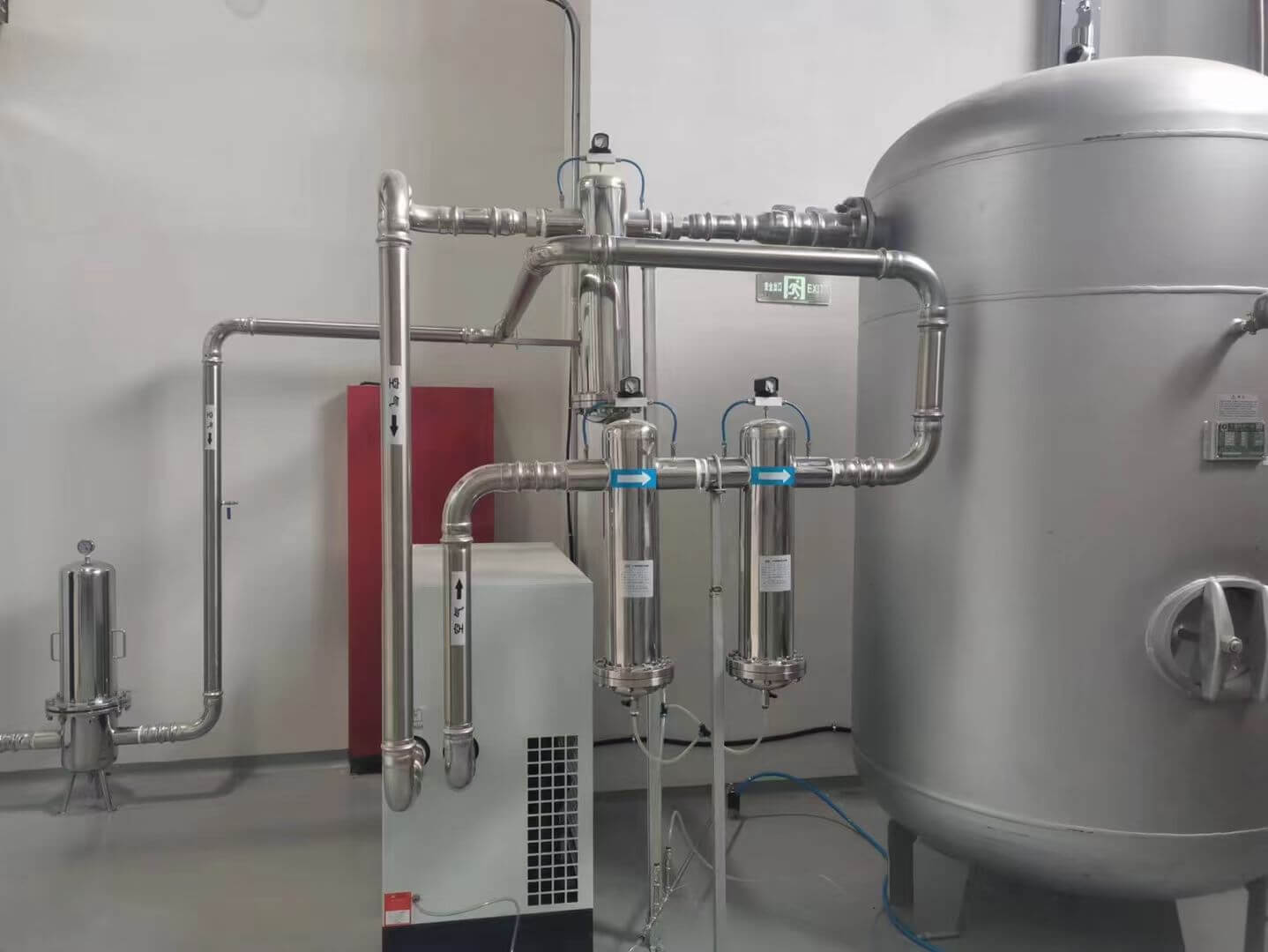
304 Stainless Steel piping (ZIQI standard) vs carbon steel after 36 months. Rust particles from corroding internal piping contaminate oil, clog the scavenge line, and prematurely fail the separator element — a pattern Kaishan users in export markets encounter as machines age past year 3.
This is the component difference that matters most for buyers outside China.
Kaishan uses a proprietary controller system. Service interval resets, fault code access, and diagnostic operations require Kaishan-authorised engineers and software. In China, where Kaishan has an extensive service network, this is manageable — service response is fast and parts are available. Outside China, it creates a permanent dependency: every software-dependent service operation requires either waiting for Kaishan support or paying OEM service rates for what would otherwise be a straightforward technician visit.
ZIQI uses Siemens Smart or Schneider Electric open-architecture controllers. Any qualified automation technician globally can service the machine fully — no proprietary software, no OEM authorisation required. In Vietnam, Nigeria, Brazil, Australia — wherever the machine is installed — local technical resources can handle all service operations independently.
ZIQI ships four third-party verifiable certificates with every unit — available before the purchase order is signed:
GHH-RAND airend origin certificate + serial number — verifiable directly with GHH-RAND
WEG IE4 motor efficiency certificate — IEC 60034-30-1 classification
Motor copper winding test report — separate third-party confirmation of pure copper content
Siemens / Schneider controller authenticity document
Kaishan does not provide equivalent component-level documentation. Their product certifications (CE, ISO 9001) confirm management systems and product safety standards — not the specific manufacturer, grade, or material of internal components. For buyers whose procurement processes require component-level traceability — international procurement standards, third-party audits, or regulated industry specifications — Kaishan cannot satisfy this requirement.
GHH-RAND airend serial number, WEG IE4 certificate, copper winding report, Siemens controller document — all four within 24 hours, before any deposit. Compare directly against Kaishan's available documentation.
| Cost Category | ZIQI (IE4 PM VSD, GHH-RAND, 304SS) | Kaishan (IE3 Fixed, Domestic Airend, Carbon Steel) |
|---|---|---|
| Purchase price (75kW) | $20,000–$24,000 | $15,000–$19,000 |
| Annual electricity | $33,480/year | $54,000/year |
| 10-year electricity | $334,800 | $540,000 |
| Separator element replacement | Every 36–48 months — $3,000 over 10 years | Every 8–12 months (carbon steel contamination) — $15,000+ over 10 years |
| Controller service (export market) | Local technician — $400–$700/visit | OEM required — $1,200–$2,400/visit |
| Airend efficiency loss | Minimal — GHH-RAND tight tolerance | +$10,000–$15,000 over 10 years |
| 10-year total cost | ~$360,000 | ~$590,000+ |
Operating 24/7 or in two shifts · Export market installation outside China · Application requires documented component specifications (food, pharma, electronics) · Long-term energy cost is a priority · No local Kaishan service centre nearby · Procurement requires third-party component traceability
Single-shift general factory use within domestic China · Kaishan service centre is local and responsive · Energy cost is not a primary driver · Short-term budget constraint is the deciding factor · Application does not require component documentation
For a full ranking of Chinese compressor manufacturers by component specification, see our China compressor brands ranking 2026. For the broader framework of what separates export-grade from domestic-grade specification, see our guide on export grade vs domestic grade Chinese compressors.
For export markets, ZIQI has four specific advantages over Kaishan: (1) Airend — ZIQI's GHH-RAND airend has tighter rotor tolerances and a traceable serial number; Kaishan's in-house airend has no independent verification. (2) Motor — ZIQI's WEG IE4 PM VSD saves $20,520/year vs Kaishan's IE3 on a 75kW unit. (3) Piping — ZIQI's 304SS piping eliminates corrosion; Kaishan's carbon steel corrodes within 3–5 years, causing recurring maintenance issues in export climates. (4) Controller — ZIQI's Siemens/Schneider open architecture can be serviced by any local technician; Kaishan's proprietary controller requires OEM support, creating downtime risk in markets without a Kaishan service centre.
Kaishan is a reliable Tier 2 domestic manufacturer — one of China's largest by unit volume, with an extensive service network inside China. Their machines perform adequately for general 8-hour factory air supply in domestic Chinese applications where Kaishan service centres are accessible. The reliability limitations emerge in export environments: carbon steel piping that corrodes faster in humid tropical climates, proprietary controllers that create service dependency outside China, and IE3 motors that generate significantly higher electricity costs over time. For export market 24/7 use, Kaishan's component specification is not matched to the application requirements.
Kaishan is typically $4,000–$6,000 cheaper upfront on a 75kW unit. Over 10 years at 6,000 operating hours/year, ZIQI saves approximately $205,200 in electricity alone (IE4 PM VSD vs IE3 fixed speed at $0.12/kWh). Adding reduced separator replacement frequency, lower controller service costs, and avoided airend efficiency degradation, the total 10-year cost advantage for ZIQI is approximately $230,000 on a single unit. The upfront price difference is recovered within 3 months of operation. Over a decade, choosing Kaishan over ZIQI for a 24/7 installation costs approximately $230,000 more per compressor.
Standard wear parts (filters, oil, separator elements) for Kaishan compressors can often be sourced from third-party suppliers globally. The critical limitation is the proprietary controller: fault code access, service interval resets, and diagnostic operations require Kaishan-authorised software and technicians. In markets without a Kaishan distributor, controller-related service issues create significant downtime. ZIQI's Siemens or Schneider controller can be serviced by any qualified local automation technician globally without OEM involvement — a fundamental operational advantage in export markets with limited Chinese brand service infrastructure.
Kaishan has the largest domestic service network of any Chinese compressor manufacturer — a genuine advantage within China. ZIQI's service advantage in export markets comes from a different architecture: open-architecture Siemens/Schneider controllers mean any qualified local technician can handle all software-dependent service operations without ZIQI involvement. Standard wear parts (filters, oil, separator elements) are available through industrial distributors globally. For the rare cases requiring ZIQI engineering support, the company provides direct WhatsApp and email technical support from Shanghai. The open controller design means ZIQI's effective service reach in export markets exceeds what a proprietary controller network of equivalent density could achieve.
GHH-RAND has been manufacturing precision screw compressor airends in Germany for decades. Their rotor profile geometry, machining tolerances, and bearing specifications represent decades of engineering refinement that no Chinese manufacturer — regardless of investment — can replicate quickly. ZIQI's model is to use the best available airend technology (GHH-RAND), the best available motor technology (WEG IE4), and build the surrounding machine to the highest specification using Chinese manufacturing capabilities. This produces a machine with equivalent core component quality to Atlas Copco and Kaeser at 40–60% lower cost. Kaishan's vertical integration model — building all components in-house — optimises for domestic cost competitiveness, not for matching international precision standards.
Data sources: IEC 60034-30-1:2014 (Motor efficiency); GHH-RAND airend engineering specifications; energy cost model: 75kW / 6,000h/year / $0.12/kWh / 70% average load factor; Kaishan product documentation (publicly available); ZIQI Compressor Group component certificates. All ZIQI certificates available on written request before purchase.
Request ZIQI's full component documentation — all four certificates — and compare directly
against whatever Kaishan can provide. The documentation tells the story.
QUICK LINKS
PRODUCTS
CONTACT US
 Email : inquiry@ziqi-group.com
 Tel: +86-15026767628
 Add:Building 2, No. 205, Jianding Road, Fengjing Town, Jinshan District, Shanghai City.China
PLEASE CONTACT US.

ZIQI Compressor (Shanghai) Co., Ltd
Copyright © 2026 ZIQI Compressor (Shanghai) Co., Ltd - All rights reserved.

